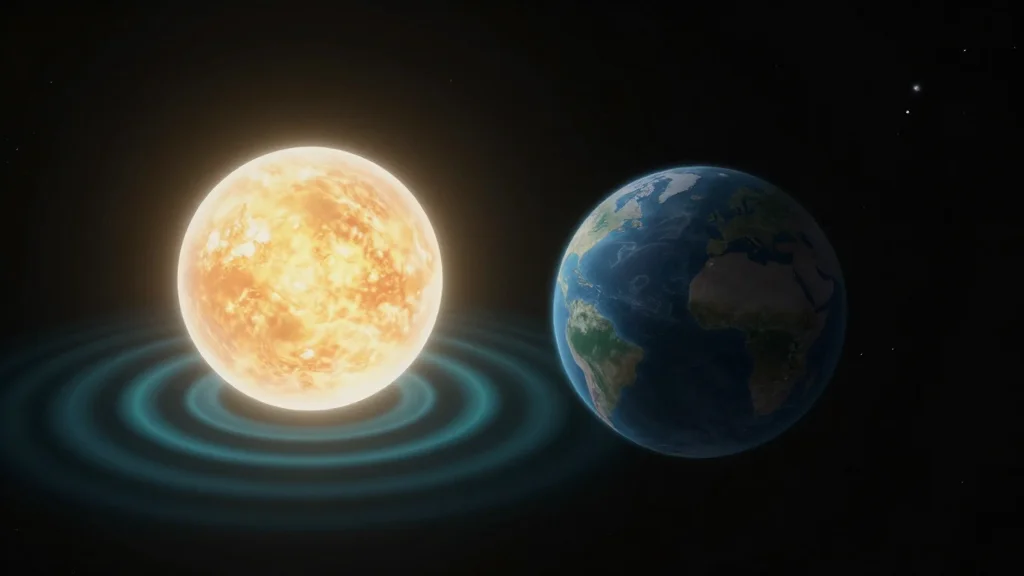
NASA Physicist Proposes Hidden ‘Fifth Force’ to Bridge Solar‑System and Cosmic Gravity Gaps

Companies Mentioned

Why It Matters
A confirmed fifth force would revolutionize our understanding of gravity, potentially providing a unified explanation for dark energy, dark matter, and the observed acceleration of the universe. It would also force a re‑evaluation of the Standard Model, prompting new particle‑physics experiments and influencing cosmological models that currently rely on mysterious energy components. Conversely, ruling out such a force would tighten constraints on modified‑gravity theories, sharpening the focus on alternative explanations for cosmic acceleration. Beyond theory, the proposal directly impacts the design of future space missions. Instruments capable of detecting minute deviations in spacecraft trajectories could become standard, driving advances in precision navigation, time‑keeping, and interferometry. The outcome will shape funding priorities for agencies like NASA and ESA, as well as the broader scientific agenda surrounding fundamental forces.
Key Takeaways
- •Slava Turyshev of NASA JPL proposes a screened fifth force to explain solar‑system vs. cosmic gravity discrepancies.
- •Two screening mechanisms are highlighted: the density‑dependent chameleon model and the gravity‑suppressing Vainshtein model.
- •The hypothesis seeks to reconcile Einstein’s general relativity with observed cosmic acceleration without invoking unknown dark energy particles.
- •Future missions (LISA, Euclid) and precise spacecraft telemetry could test the fifth‑force predictions.
- •Validation would upend the Standard Model and reshape the search for dark energy and dark matter.
Pulse Analysis
Turyshev’s fifth‑force proposal arrives at a moment when the physics community is increasingly skeptical of dark‑energy explanations that rely solely on a cosmological constant. By framing the problem in terms of screening, the theory offers a testable pathway that bridges high‑precision solar‑system measurements with large‑scale cosmological observations. Historically, attempts to modify gravity—such as MOND or scalar‑tensor theories—have struggled to survive both solar‑system constraints and cosmological data. The chameleon and Vainshtein models, however, explicitly incorporate environmental dependence, a clever way to sidestep past failures.
If experimentalists can isolate a signal within the Vainshtein radius, it would provide the first empirical foothold for a new fundamental interaction, opening a cascade of theoretical work to integrate it with quantum field theory. This could trigger a wave of funding for precision‑navigation experiments, similar to the surge in interest that followed the detection of gravitational waves. On the other hand, a null result would tighten the noose around many modified‑gravity proposals, reinforcing the cosmological‑constant paradigm and shifting focus toward particle‑physics solutions for dark energy.
In either scenario, Turyshev’s work underscores a broader shift: the next frontier in fundamental physics is no longer purely theoretical but hinges on engineering breakthroughs that can measure the universe’s subtle whispers. The coming decade will likely see a convergence of astrophysics, metrology, and spacecraft engineering as the community strives to answer whether a hidden fifth force truly shapes our cosmos.
NASA Physicist Proposes Hidden ‘Fifth Force’ to Bridge Solar‑System and Cosmic Gravity Gaps
Comments
Want to join the conversation?
Loading comments...