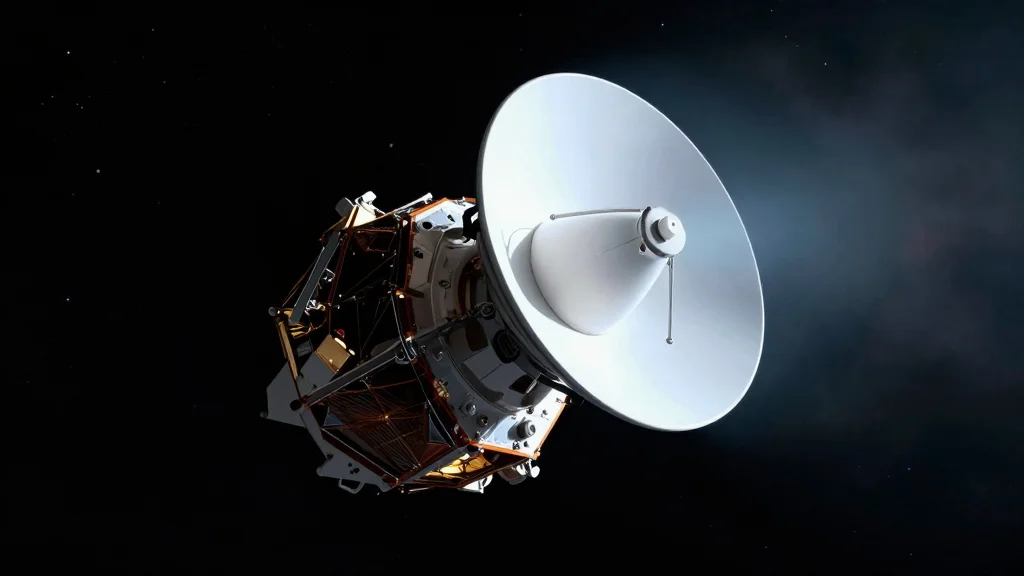
NASA Powers Down Voyager 1’s LECP Instrument to Extend Interstellar Mission

Why It Matters
Voyager 1’s continued operation provides a unique, real‑time laboratory for studying the interstellar environment, data that cannot be replicated by any Earth‑bound observatory. Each additional year of measurements refines our understanding of how the Sun’s magnetic bubble interacts with the galaxy, informing space weather forecasts that affect satellite operations and astronaut safety. The power‑conservation strategy also serves as a case study for managing aging spacecraft, offering lessons for future deep‑space explorers that will depend on long‑lived energy sources. As agencies plan missions to the outer Solar System and beyond, the trade‑offs made by the Voyager team will shape design choices for power, redundancy, and instrument prioritization.
Key Takeaways
- •Voyager 1’s Low‑energy Charged Particles (LECP) instrument was shut down on April 17, 2026.
- •The spacecraft’s RTGs now generate less than 50% of their original power, declining about 4 watts per year.
- •Voyager 1 is approximately 25 billion km (15 billion miles) from Earth, requiring a 23‑hour command round‑trip.
- •Previous shutdowns include the Cosmic Ray Subsystem in Feb 2025 and imaging systems since 1990.
- •Data from remaining instruments will continue to map the heliopause and interstellar magnetic fields.
Pulse Analysis
The latest instrument retirement on Voyager 1 illustrates the inevitable tension between scientific ambition and engineering reality in long‑duration missions. While the loss of LECP data narrows the probe’s particle‑physics portfolio, the decision safeguards the spacecraft’s core telemetry and thermal stability, effectively buying more time for the remaining sensors to deliver high‑value science. This pragmatic approach mirrors the broader shift in NASA’s deep‑space strategy, where mission extensions are increasingly framed as cost‑effective ways to extract maximum return from legacy hardware.
Historically, Voyager’s longevity has hinged on the reliability of its RTGs, a technology that is now reaching the limits of its usable lifespan. The power shortfall forces mission planners to confront a hard ceiling on how long a probe can remain scientifically productive without external power augmentation. The upcoming Interstellar Probe concept, slated for a 2030s launch, is already incorporating advanced radioisotope generators and more efficient power management architectures, lessons directly drawn from Voyager’s experience.
Looking ahead, the Voyager team’s disciplined shutdown sequence sets a precedent for future missions that may operate for decades beyond their primary objectives. By establishing clear criteria for instrument retirement, NASA can maintain transparency with the scientific community and ensure that each decision is driven by a balance of data value and spacecraft health. As the interstellar frontier becomes a focal point for both governmental and commercial explorers, the Voyager story will likely serve as a benchmark for how humanity manages the twilight years of its most distant emissaries.
NASA Powers Down Voyager 1’s LECP Instrument to Extend Interstellar Mission
Comments
Want to join the conversation?
Loading comments...