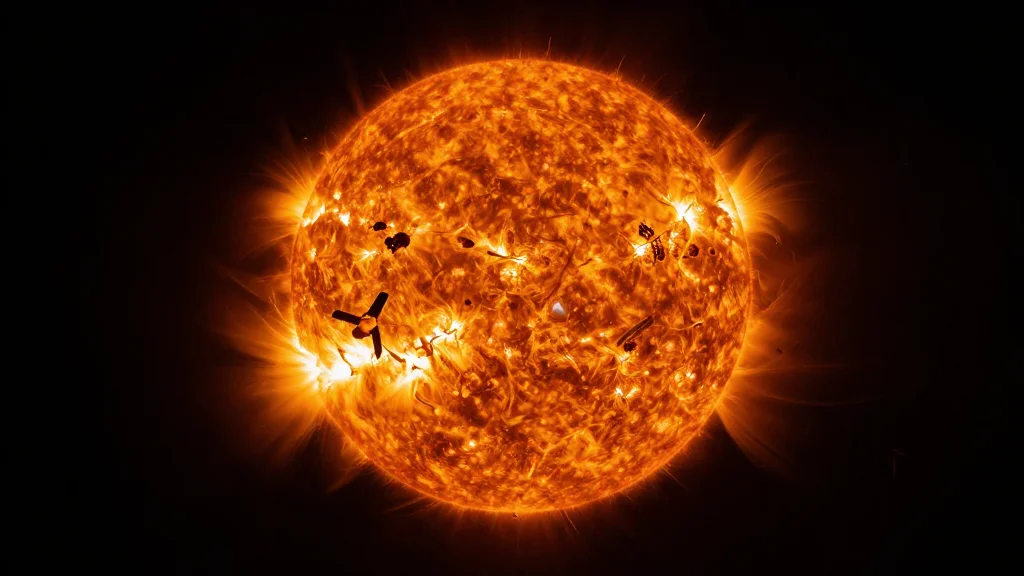
NASA Records Back-to-Back X2.4 and X2.5 Solar Flares, Prompting Space‑Weather Alerts

Why It Matters
The twin X‑class flares highlight the vulnerability of modern infrastructure to solar activity. Disruptions to GPS can affect navigation for aviation, shipping and autonomous vehicles, while radio‑communication outages can impede emergency response. Power‑grid disturbances, though rare, have historically caused widespread blackouts, as seen in the 1989 Quebec storm. By documenting the flares and the immediate response, the event serves as a real‑time case study for improving space‑weather preparedness across sectors. Beyond immediate operational concerns, the flares provide valuable data for solar physicists studying magnetic reconnection and particle acceleration. Understanding the mechanisms that produce back‑to‑back X‑class events can refine predictive models of the solar cycle, ultimately aiding long‑term planning for satellite design, astronaut safety and terrestrial power‑grid hardening.
Key Takeaways
- •NASA’s Solar Dynamics Observatory captured an X2.4 flare at 9:07 p.m. ET on April 23 and an X2.5 flare at 4:13 a.m. ET on April 24.
- •Both flares belong to the strongest X‑class category, with the second slightly more intense.
- •NOAA’s Space Weather Prediction Center issued elevated alerts for the next 48 hours, advising satellite operators and airlines to monitor systems.
- •Potential impacts include HF‑radio disruption, GPS positioning errors, induced currents in power grids, and increased radiation exposure for spacecraft and astronauts.
- •NASA, NOAA and international partners are intensifying solar monitoring to improve forecasting and mitigation strategies.
Pulse Analysis
The back‑to‑back X‑class flares arrive at a pivotal moment for the space‑weather industry. Over the past decade, the cost of a major geomagnetic storm has been estimated at $2‑$6 billion in lost productivity, equipment damage and grid repair. The recent events, while not yet causing measurable outages, act as a stress test for the alert chain that links NASA’s solar observatories to NOAA’s forecasting centers and downstream commercial users. The rapid issuance of elevated alerts demonstrates that the operational framework is functional, yet the true test will be the response of satellite operators and grid managers when a coronal mass ejection follows.
Historically, the most damaging storms have been preceded by X‑class flares that launched fast‑moving CMEs toward Earth. The dual nature of the April 23‑24 flares raises the probability of a compounded event, a scenario that could overwhelm current mitigation protocols. Companies that rely on low‑Earth‑orbit constellations, such as SpaceX’s Starlink or OneWeb, are likely to adjust orbital maneuvers and power‑budget allocations in anticipation of heightened radiation, potentially incurring additional operational costs.
Looking ahead, the scientific community is leveraging the high‑resolution imagery from the Solar Dynamics Observatory to refine magnetic‑field models of the active region that produced the flares. Improved modeling could shorten the warning window from days to hours, giving utilities and airlines more actionable time. Policymakers, meanwhile, are beginning to factor space‑weather risk into infrastructure resilience legislation, a trend that could spur new public‑private partnerships focused on hardening the grid and developing radiation‑shielding technologies for spacecraft. In sum, the twin flares are a reminder that solar activity remains a systemic risk, and the industry’s ability to translate observations into timely, effective action will define the next era of space‑weather preparedness.
NASA Records Back-to-Back X2.4 and X2.5 Solar Flares, Prompting Space‑Weather Alerts
Comments
Want to join the conversation?
Loading comments...