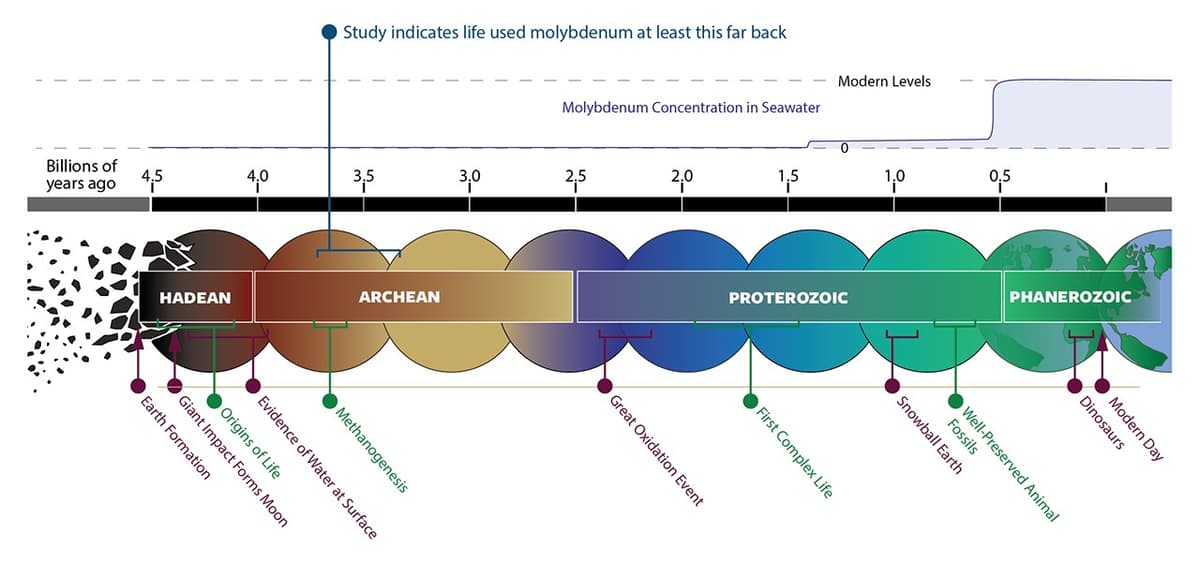
NASA Research Shows Early Life Relied on Rare Metal
Why It Matters
Identifying molybdenum as an early bio‑essential metal reshapes models of metabolic evolution and informs the search for life on planets with different metal inventories. It highlights that elemental scarcity does not preclude biochemical innovation, expanding criteria for planetary habitability.
Key Takeaways
- •Ancient microbes used molybdenum 3.7–3.1 billion years ago
- •Molybdenum catalyzed carbon, nitrogen, sulfur cycles despite scarcity
- •Hydrothermal vents likely supplied trace molybdenum to early life
- •Findings reshape models of metal utilization in planetary habitability
Pulse Analysis
Molybdenum’s role as a catalytic hub in modern enzymes is well‑known, but the new NASA‑backed research pushes its biological relevance deep into the Archean eon. By integrating geochemical records with molecular dating, the team placed molybdenum‑dependent metabolism at roughly 3.7 to 3.1 billion years ago, predating the Great Oxidation Event by over a billion years. This early adoption implies that primitive microbes evolved sophisticated metal‑handling strategies even when the element was a trace constituent of the oceans, underscoring the metal’s unparalleled catalytic versatility across redox conditions.
Geological evidence shows that bulk oceanic molybdenum concentrations were minuscule during the Eoarchean and Mesoarchean, yet localized environments such as hydrothermal vent systems could concentrate trace metals. These niches likely acted as natural reactors, delivering sufficient molybdenum—and even tungsten—to nascent microbial communities. The study’s reconstruction of enzyme evolution suggests that early life did not follow a linear “tungsten‑first, molybdenum‑later” pathway; instead, both metals were exploited in parallel, providing a biochemical safety net that may have accelerated the diversification of metabolic networks.
For astrobiology, the implications are profound. Planetary habitability assessments often prioritize Earth‑like oxygen levels and bulk elemental abundances, but this work argues that the evolutionary history of bio‑essential metals must also be considered. Worlds with different redox histories or metal inventories could still foster life if organisms evolve analogous catalytic solutions. Consequently, future missions searching for biosignatures should adopt a “metal‑aware” lens, expanding the palette of detectable metabolic pathways beyond the modern Earth template.
NASA Research Shows Early Life Relied on Rare Metal
Comments
Want to join the conversation?
Loading comments...