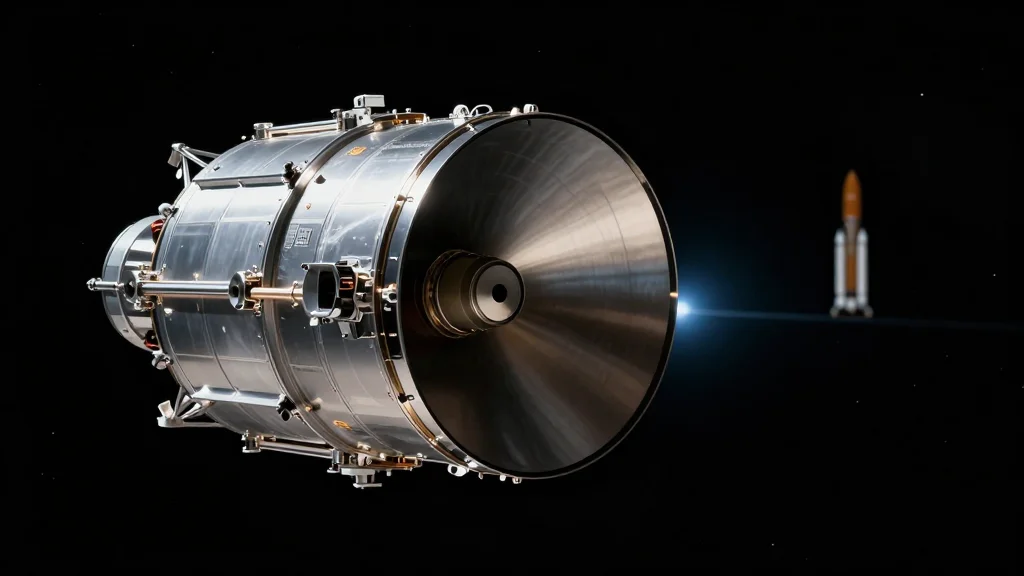
NASA Targeting September to Launch Nancy Grace Roman Space Telescope
Companies Mentioned

NASA
SpaceX
Why It Matters
An accelerated, under‑budget launch delivers groundbreaking cosmology data sooner and validates a public‑private development model that could shape future flagship missions.
Key Takeaways
- •Launch set for early September on SpaceX Falcon Heavy
- •Telescope scans sky 1,000× faster than Hubble
- •First coronagraph images exoplanets, paving way for Habitable Worlds Observatory
- •Program completed under budget after $300 million congressional funding
- •Operations expected by year‑end after L2 deployment and calibration
Pulse Analysis
The Nancy Grace Roman Space Telescope, NASA’s next flagship, is poised for an early September launch, a remarkable eight‑month acceleration that underscores the agency’s ability to streamline complex projects when public investment aligns with private launch capability. By leveraging SpaceX’s Falcon Heavy, NASA not only cuts schedule risk but also demonstrates a cost‑effective partnership model that could become a template for future deep‑space observatories. The $300 million congressional infusion after a proposed cancellation helped keep the program on track, highlighting the political will to preserve high‑impact science missions despite fiscal pressures.
Roman’s scientific payload sets a new benchmark for wide‑field astronomy. Its 2.4‑meter primary mirror coupled with the Wide Field Instrument enables sky surveys a thousand times faster than the Hubble Space Telescope, promising unprecedented maps of dark matter distribution and dark energy dynamics. The mission will also conduct a massive census of billions of stars and thousands of exoplanets, delivering data that will refine models of galaxy evolution. The onboard coronagraph, the first space‑based adaptive‑optics system of its kind, aims to capture direct images of Jupiter‑size exoplanets, providing a crucial technology demonstrator for the upcoming Habitable Worlds Observatory slated for the 2040s.
Beyond its immediate scientific returns, Roman serves as a proving ground for next‑generation mission architecture. Successful deployment at the Sun‑Earth L2 point—shared with the James Webb Space Telescope—will validate integration processes and operational timelines that can be replicated for future large‑aperture observatories. The program’s ability to stay under budget after earlier cost escalations offers a case study in disciplined project management, potentially influencing how Congress and the White House evaluate and fund ambitious space endeavors. As the first images are expected by the end of 2026, the astronomy community and commercial partners alike will watch closely for lessons that could accelerate the cadence of flagship launches in the coming decade.
NASA targeting September to launch Nancy Grace Roman Space Telescope
Comments
Want to join the conversation?
Loading comments...