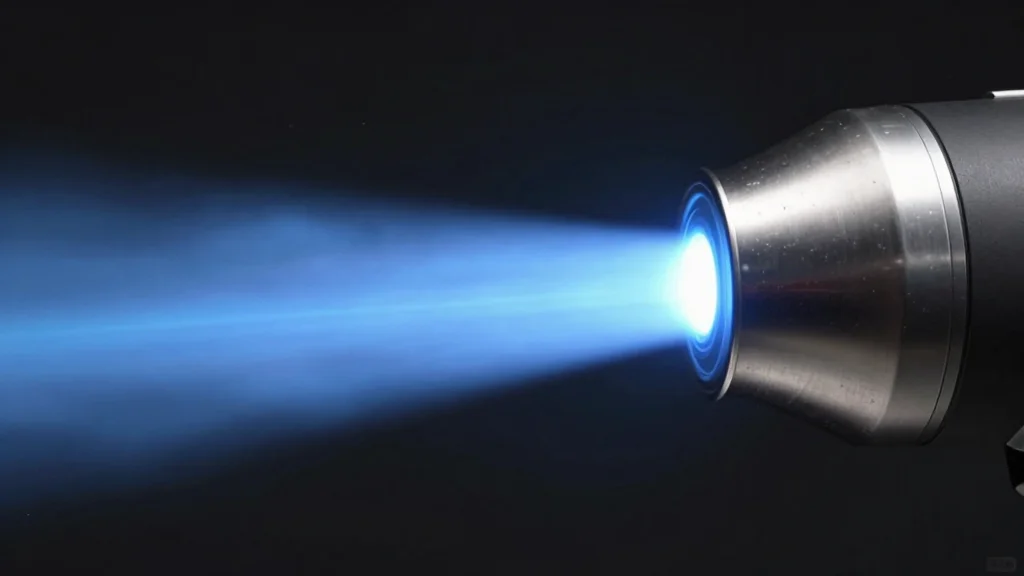
NASA's 120‑Kilowatt Electric Thruster Sets New Record for Future Mars Missions

Why It Matters
The thruster’s record power output validates a propulsion concept that could fundamentally reshape how humanity reaches Mars and beyond. By dramatically lowering propellant mass, electric propulsion makes deep‑space missions more affordable and opens the possibility of larger, more capable crewed habitats en route to the Martian surface. Beyond Mars, the technology could enable faster missions to the outer planets, asteroid mining operations, and rapid response to near‑Earth objects. The ability to generate high thrust with relatively low fuel consumption is a game‑changing capability for any long‑duration, high‑energy space endeavor.
Key Takeaways
- •NASA JPL tested a lithium‑vapor electric thruster delivering 120 kW, a U.S. record
- •Power level is 25× higher than the Psyche mission’s thrusters
- •Thruster withstood >2,800 °C during continuous operation
- •Electric propulsion can cut propellant use by up to 90 % versus chemical rockets
- •Future crewed Mars missions will need 2‑4 MW and >23,000 hours of operation
Pulse Analysis
The 120‑kilowatt breakthrough arrives at a moment when NASA’s deep‑space ambitions are converging on crewed Mars exploration and a broader push for sustainable propulsion. Historically, electric thrusters have been confined to small‑scale scientific probes because of limited thrust and power. By moving the power envelope into the hundreds of kilowatts, NASA is crossing a threshold that could make electric propulsion viable for human‑rated spacecraft.
Scaling from 120 kW to the multi‑megawatt levels required for a Mars transfer will demand advances in power processing, thermal control, and long‑duration reliability. Competitors in the commercial sector, such as SpaceX and Blue Origin, are betting on high‑thrust chemical engines and, more recently, nuclear thermal concepts. NASA’s approach offers a complementary pathway that could reduce launch mass and cost, potentially reshaping the economics of interplanetary travel. If the agency can demonstrate a reliable megawatt‑class electric system, it may attract private partners seeking to lower the barrier to deep‑space missions.
Looking ahead, the key risk lies in the integration of the thruster with a spacecraft‑wide power architecture that can sustain megawatt outputs for years without degradation. Success will hinge on solving thermal‑management challenges and ensuring that the lithium‑vapor feed system remains stable over thousands of hours. The upcoming multi‑thruster test in 2027 will be a decisive indicator of whether the technology can transition from laboratory record‑setter to flight‑ready hardware, setting the stage for the next generation of human exploration beyond low Earth orbit.
NASA's 120‑Kilowatt Electric Thruster Sets New Record for Future Mars Missions
Comments
Want to join the conversation?
Loading comments...