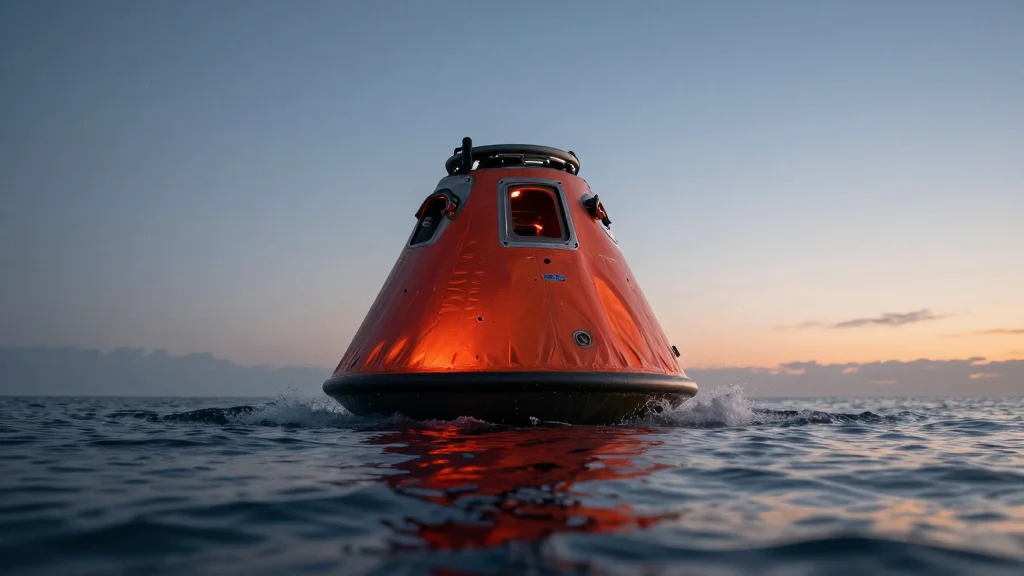
NASA’s Artemis II Crew Is Expected to Splash Down Friday Evening
Why It Matters
A successful splashdown proves Orion’s re‑entry capability, a critical step toward returning humans to the Moon and sustaining NASA’s Artemis lunar agenda.
Key Takeaways
- •Splashdown scheduled for Friday 8:07 p.m. Eastern.
- •Orion heat shield faces extreme temperatures during reentry.
- •Crew: Wiseman, Glover, Koch, and Hansen.
- •Mission validates deep‑space crewed flight systems.
- •Success clears path for Artemis III lunar landing.
Pulse Analysis
The Artemis II flight, NASA’s first crewed test of the deep‑space Orion capsule, lifted off on 5 April 2026 and spent just over six days orbiting the Moon before beginning its return trajectory. Unlike the Apollo missions, Artemis II does not attempt a lunar landing; instead it serves as a high‑risk rehearsal for the systems that will carry astronauts to the lunar surface on Artemis III. The mission’s four‑person crew—commander Reid Wiseman, pilot Victor Glover, and mission specialists Christina Koch and Jeremy Hansen—has been closely monitored by both the agency and commercial partners eager to see the spacecraft’s performance in real‑world conditions.
The critical phase of the flight is the re‑entry and splashdown, scheduled for Friday at roughly 8:07 p.m. Eastern. During this interval Orion’s ablative heat shield must endure temperatures exceeding 5,000 °F (2,760 °C) while the capsule experiences peak deceleration forces of up to 8 g. Engineers will scrutinize telemetry for any signs of thermal erosion, structural stress, or coolant system anomalies. A clean heat‑shield performance not only safeguards the crew but also confirms the design margins required for the higher‑velocity return from a lunar surface mission.
Assuming a flawless splashdown, Artemis II will unlock the next milestone in NASA’s lunar roadmap: the Artemis III crewed landing slated for 2027. The data gathered will feed into refinements of Orion’s life‑support, navigation, and communication suites, while also informing the commercial lunar payload services that are being integrated into the program. Moreover, a successful return bolsters confidence among international partners and private investors, reinforcing the United States’ leadership in deep‑space exploration and setting the stage for future missions to Mars.
NASA’s Artemis II crew is expected to splash down Friday evening
Comments
Want to join the conversation?
Loading comments...