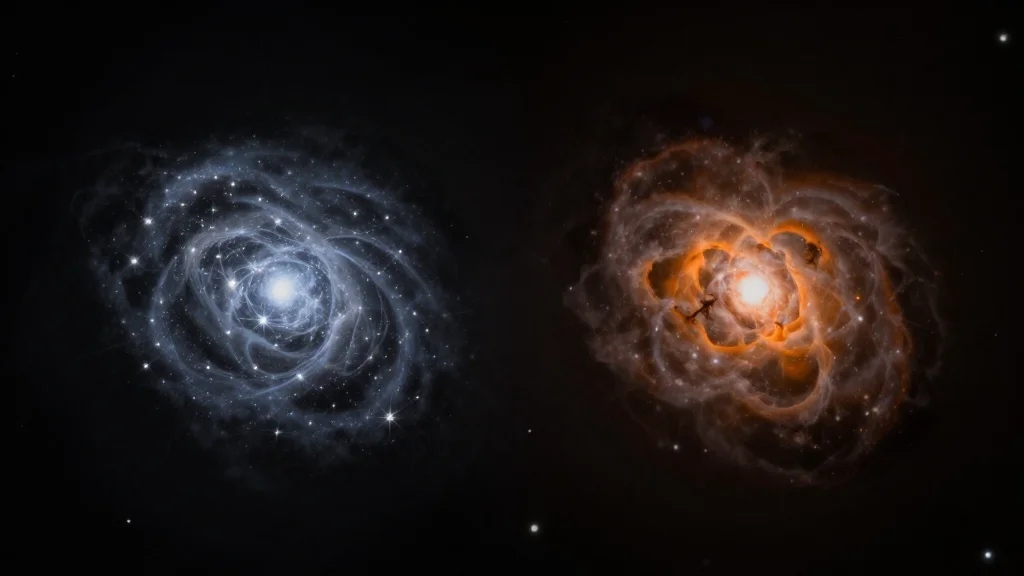
NASA’s Chandra Finds Young Stars Dim Quickly
Why It Matters
A faster decline in stellar X‑ray output lowers atmospheric erosion on young exoplanets, refining habitability estimates and guiding target selection for future missions.
Key Takeaways
- •Young Sun-like stars emit only 25‑33% expected X-rays
- •Study covered clusters aged 45‑750 million years
- •Reduced X-ray output benefits planetary habitability prospects
- •Findings contradict previous stellar activity models
- •Combined Chandra X-ray and PanSTARRS optical data
Pulse Analysis
Young Sun‑like stars are prodigious X‑ray sources, a by‑product of intense magnetic activity that drives stellar winds and flares. For decades, astrophysicists have used this high‑energy output as a benchmark for early stellar evolution and as a key factor in modeling atmospheric loss on nearby planets. Conventional models predicted a gradual decline over billions of years, with young stars retaining roughly three‑quarters of their peak X‑ray luminosity for the first few hundred million years. The new Chandra observations force a reassessment of that timeline.
The study, released April 14, 2026, combined Chandra’s X‑ray imaging with PanSTARRS optical and infrared data for eight open clusters, including Trumpler 3 and NGC 2353. Ages spanned 45 million to 750 million years, providing a cross‑section of stellar youth. Researchers measured X‑ray fluxes and found Sun‑like members emitted only about a quarter to a third of the photons their models anticipated. This rapid dimming implies that planetary atmospheres experience far less high‑energy bombardment during the critical early epochs, easing the erosion of volatile compounds essential for life.
These findings ripple through exoplanet science, where X‑ray and ultraviolet radiation are primary drivers of atmospheric escape. Mission concepts such as the Habitable Worlds Observatory will now factor a faster decline in stellar aggression when selecting target stars, potentially widening the pool of candidates with stable, life‑supporting climates. Moreover, stellar evolution codes must integrate the new decay rates to improve predictions of magnetic activity cycles. As the community refines these models, the prospect of finding Earth‑like worlds around young Sun analogs becomes more plausible, sharpening the focus of future observational campaigns.
NASA’s Chandra Finds Young Stars Dim Quickly
Comments
Want to join the conversation?
Loading comments...