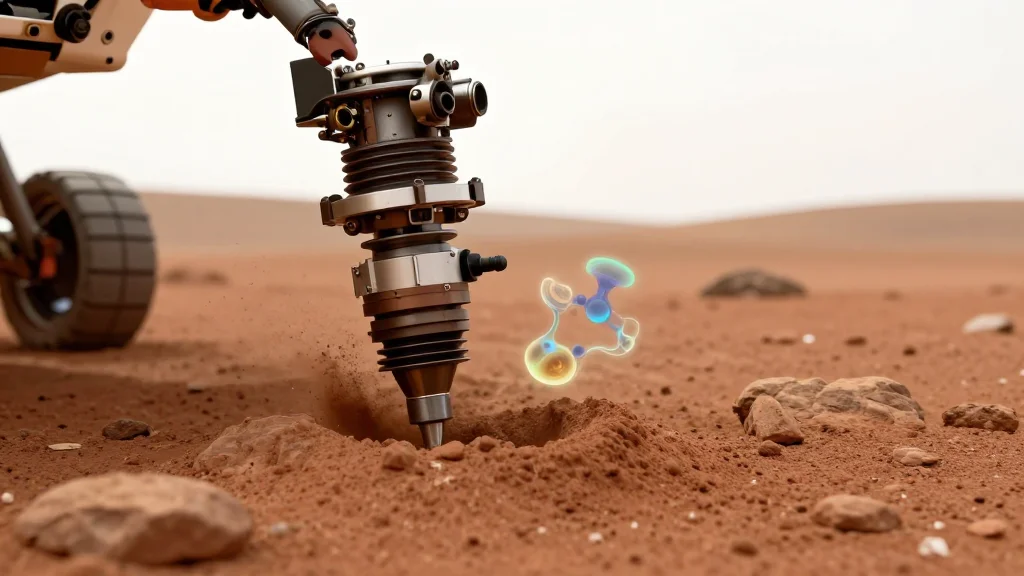
NASA’s Curiosity Finds Organic Molecules Never Seen Before on Mars
Why It Matters
The discovery reshapes our understanding of Mars’ habitability and bolsters the scientific case for upcoming sample‑return missions, potentially bringing the first extraterrestrial organics to Earth for detailed study.
Key Takeaways
- •Curiosity’s SAM instrument detected novel organics in Gale Crater
- •Molecules include complex aromatic and nitrogen‑bearing compounds
- •Findings suggest ancient Martian environments supported prebiotic chemistry
- •Discovery strengthens the rationale for Mars sample‑return missions
- •Data gathered during the 2025‑2026 drilling campaign
Pulse Analysis
The Curiosity rover, operating since 2012, continues to push the boundaries of planetary science. In its latest campaign, the Sample Analysis at Mars (SAM) suite heated drilled rock samples, revealing a suite of organic molecules that had never been cataloged on the Red Planet. Unlike earlier detections of simple chlorobenzene and thiophenes, these new compounds feature multi‑ring aromatic structures and nitrogen heterocycles, indicating a higher level of chemical complexity than previously assumed.
Scientists interpret the presence of such organics as a sign that ancient Martian environments possessed the right conditions—water, energy sources, and stable mineral matrices—to foster pre‑biotic chemistry. The findings dovetail with earlier evidence of ancient lakebeds and hydrothermal systems in Gale Crater, suggesting that the planet once hosted a chemically rich milieu. While the organics themselves are not definitive proof of life, their complexity narrows the gap between abiotic synthesis and the building blocks needed for biology, prompting renewed debate about Mars’ potential to have harbored microbial life.
The broader impact of this discovery reverberates through NASA’s roadmap for Mars exploration. It adds urgency to the Mars Sample Return (MSR) campaign, slated for the late 2020s, by providing a compelling target for pristine material retrieval. Commercial partners and international agencies are also watching closely, as the presence of diverse organics could influence future lander designs and in‑situ resource utilization strategies. Ultimately, Curiosity’s unexpected find underscores the value of sustained, on‑the‑ground analysis in uncovering planetary secrets that orbiters alone cannot resolve.
NASA’s Curiosity Finds Organic Molecules Never Seen Before on Mars
Comments
Want to join the conversation?
Loading comments...