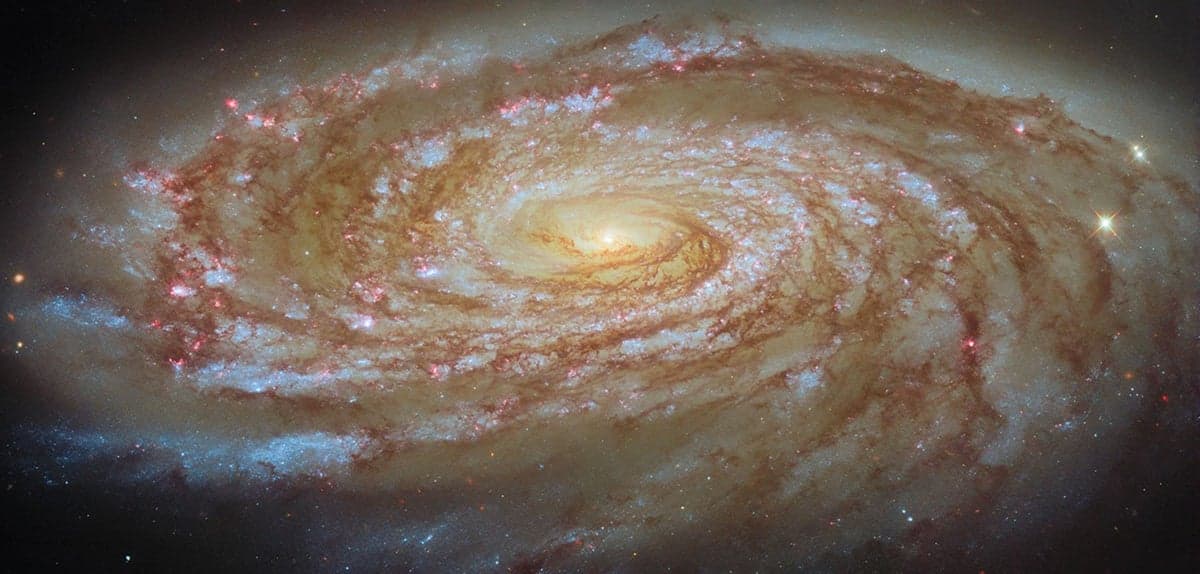
NASA’s Hubble Captures Gorgeous New Photo of a Spiral Galaxy as It Wanders Through the Virgo Cluster
Why It Matters
The observation showcases how dense cluster environments can quench star formation by stripping gas, a key process in galaxy evolution models. It also provides a rare, near‑term view of an impending major galactic encounter, informing predictions of future structural changes.
Key Takeaways
- •Hubble image reveals M88’s 100‑million‑solar‑mass black hole activity.
- •Galaxy’s gas is being stripped as it falls toward Virgo Cluster core.
- •M88 will pass near M87 in 200‑300 million years.
- •Reduced cold gas hints at suppressed star formation in cluster environment.
Pulse Analysis
The Hubble capture of Messier 88 adds a vivid visual to our understanding of galaxies embedded in massive clusters. While the Virgo Cluster hosts over a thousand galaxies, M88 stands out for its size—roughly 130,000 light‑years across—and its active nucleus, which powers bright emissions across the spectrum. The new image’s high resolution reveals intricate spiral arms, star clusters, and dust lanes, allowing astronomers to map the distribution of gas that fuels future star formation. By placing M88 in the broader context of Virgo, researchers can compare its morphology against less‑disturbed field galaxies.
A striking feature of the photograph is the evidence of ram‑pressure stripping, a process where the intracluster medium exerts a wind‑like force on a galaxy moving at high speed. As M88 speeds toward the cluster’s gravitational center, its outer gas layers are compressed and peeled away, reducing the reservoir needed for new stars. This loss explains why the galaxy appears deficient in cold gas relative to its mass. The phenomenon is a cornerstone of modern astrophysics, illustrating how environment can accelerate the transition from star‑forming spirals to quiescent ellipticals.
Looking ahead, M88’s projected close approach to the massive elliptical Messier 87 within the next few hundred million years promises a dramatic interaction. Simulations suggest that tidal forces and further gas stripping could reshape both galaxies, potentially igniting bursts of star formation or feeding their central black holes. Continued monitoring with Hubble, the James Webb Space Telescope, and upcoming ground‑based observatories will track these changes, sharpening models of cluster‑driven evolution and informing how similar processes may have shaped the early universe’s galaxy population.
NASA’s Hubble captures gorgeous new photo of a spiral galaxy as it wanders through the Virgo Cluster
Comments
Want to join the conversation?
Loading comments...