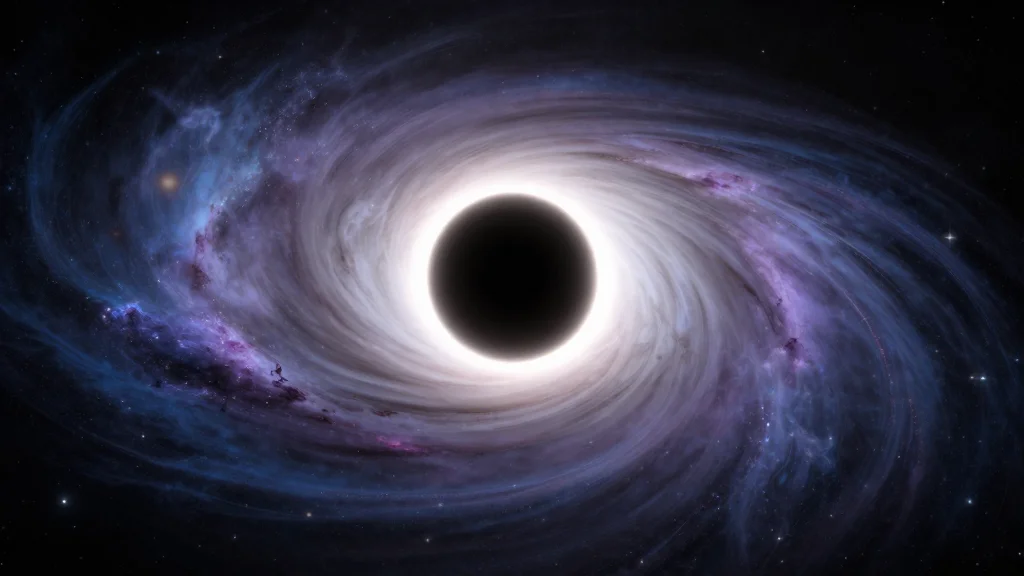
NASA’s JWST Reveals Black Hole That Formed Before Its Galaxy
Why It Matters
The observation upends prevailing theories that black holes and galaxies co‑evolve, suggesting black holes can precede and possibly drive early galaxy formation. It forces astronomers to rethink models of seed black‑hole creation and rapid growth in the early universe.
Key Takeaways
- •JWST detected a 1‑billion‑solar‑mass black hole at redshift ~7.5.
- •Host galaxy’s stellar mass is ten times lower than the black hole.
- •Black hole formed before most of its galaxy’s stars.
- •Findings challenge conventional models of simultaneous black‑hole‑galaxy growth.
Pulse Analysis
The James Webb Space Telescope’s latest spectroscopic data has opened a new window on the universe’s infancy, revealing a supermassive black hole that predates the bulk of its host galaxy’s stars. By measuring the redshifted emission lines of the object, astronomers determined it existed when the cosmos was under a billion years old, a period previously thought too brief for such massive black holes to assemble. This breakthrough underscores JWST’s unparalleled sensitivity in the infrared, allowing scientists to probe the faintest, most distant objects with unprecedented clarity.
Traditional cosmological models posit that black holes and their galaxies grow in lockstep, each feeding off the other’s material. The newly discovered black hole, however, is disproportionately massive compared to its galaxy, implying a rapid, perhaps direct‑collapse, formation pathway that bypasses the gradual accretion expected in early galaxies. This challenges the standard hierarchical framework and suggests that massive black‑hole seeds could have formed from dense gas clouds or early star clusters, accelerating growth well before substantial stellar mass accumulated.
The implications extend beyond theoretical astrophysics. Understanding how early black holes influence galaxy formation informs predictions about the reionization era, the distribution of matter, and the evolution of large‑scale cosmic structures. Future JWST observations, combined with next‑generation facilities like the Nancy Grace Roman Space Telescope, will target similar high‑redshift systems to test these emerging hypotheses, potentially reshaping our narrative of the universe’s first billion years.
NASA’s JWST Reveals Black Hole That Formed Before Its Galaxy
Comments
Want to join the conversation?
Loading comments...