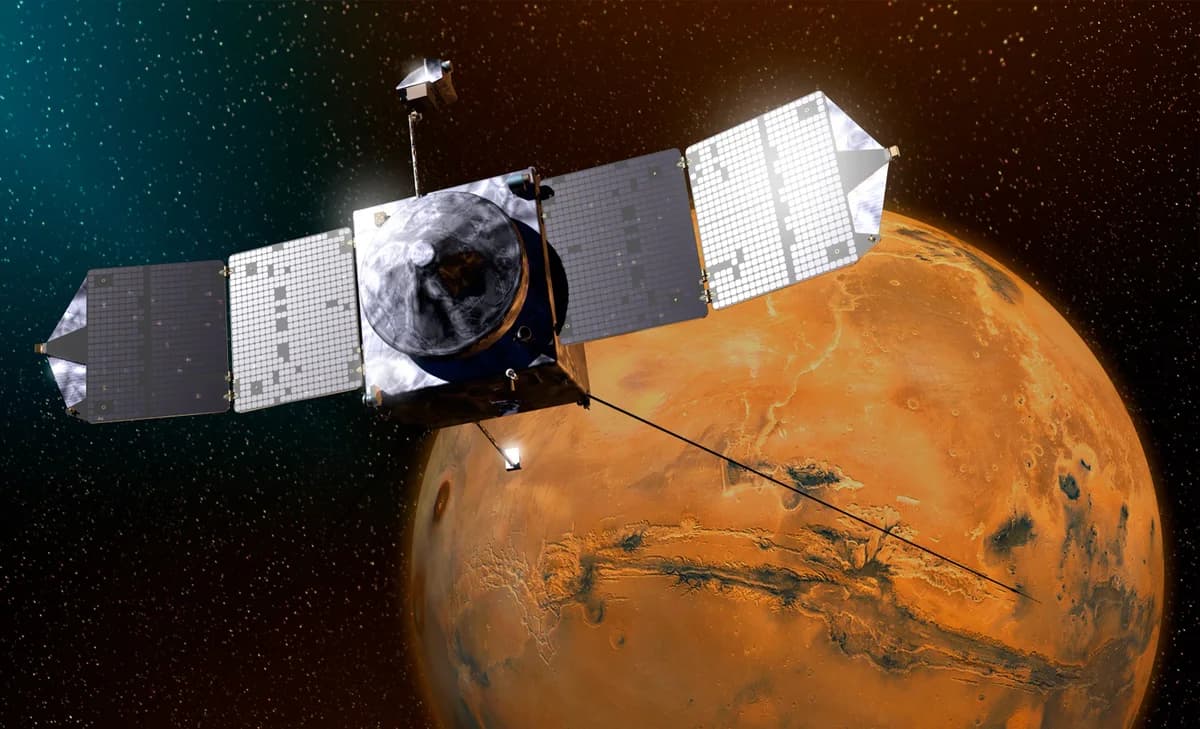
NASA’s Mars Mission MAVEN Is Lost Forever
Companies Mentioned

Why It Matters
MAVEN’s loss removes a critical communications relay and a unique source of atmospheric data, tightening constraints on future Mars exploration and human‑mission planning. The gap forces NASA to rely more heavily on ESA’s Trace Gas Orbiter and accelerates the need for a replacement relay spacecraft.
Key Takeaways
- •MAVEN lost contact after unexpected rotation on Dec 4, 2025.
- •Mission provided key data on atmospheric loss and solar storm effects.
- •Its relay role was second only to ESA’s Trace Gas Orbiter.
- •Loss creates gap in Mars communications network for rovers.
Pulse Analysis
MAVEN’s decade‑long tenure reshaped our understanding of the Red Planet’s thin atmosphere. By measuring how solar wind strips away gases, the orbiter quantified the rate of atmospheric erosion, revealing that solar storms can accelerate loss by up to 30 percent during peak events. Those findings are now foundational for models that predict how long a breathable environment could be sustained, a prerequisite for any crewed mission. The dataset also captured rare phenomena such as high‑altitude auroras and the atmospheric response to comet Siding Spring, enriching planetary science curricula worldwide.
Beyond its scientific legacy, MAVEN functioned as a vital link in the Mars Relay Network, handling roughly 30‑40 percent of data traffic between Earth and surface rovers. Its loss leaves NASA’s communication architecture reliant on ESA’s Trace Gas Orbiter and two aging NASA orbiters, increasing latency and risk of data gaps during critical rover operations. The agency is already evaluating rapid‑deployment relay concepts, including smallsat constellations and high‑bandwidth laser links, to restore redundancy and safeguard future missions.
The termination of MAVEN also underscores the operational challenges of deep‑space assets, especially during solar conjunctions when Sun‑blocked geometry hampers contact. As NASA plans its next generation of Mars explorers, the agency must integrate more robust fault‑tolerance and autonomous navigation to mitigate similar failures. The experience will inform design standards for the upcoming Mars Sample Return and eventual human landings, ensuring that both science and communications remain resilient in the harsh Martian environment.
NASA’s Mars mission MAVEN is lost forever
Comments
Want to join the conversation?
Loading comments...