NASA’s Moon Base Vision Includes Swarms of Lunar Robots

Companies Mentioned
Why It Matters
By leveraging swarms of autonomous machines, NASA aims to cut launch costs, accelerate habitat construction, and develop the skilled workforce needed for sustained lunar and Martian exploration.
Key Takeaways
- •NASA plans up to 30 robotic lunar landings by 2027.
- •Modular robots will autonomously assemble habitats and solar arrays.
- •Cooperative rover teams can map terrain faster than single units.
- •Skyfall helicopters will scout Mars sites for future crewed missions.
Pulse Analysis
NASA’s emphasis on autonomous robotics marks a shift from traditional astronaut‑centric construction to a machine‑driven paradigm for lunar habitation. The upcoming CLPS missions, slated for as many as 30 landings in 2027, will deliver a fleet of rovers, hoppers and drones that perform reconnaissance, test subsurface conditions, and lay the groundwork for power and communication networks. By staging these capabilities before humans arrive, NASA reduces the mass and complexity of payloads launched from Earth, a critical factor given the high cost of lunar transport.
At the heart of the plan are modular robotic systems such as the Automated Reconfigurable Mission Adaptive Digital Assembly System. Small, interchangeable units can self‑organize to erect large structures—habitats, solar arrays, and antennae—directly on the Moon’s surface, dramatically lowering the need for pre‑built hardware. Complementary Cooperative Autonomous Distributed Robotic Exploration rovers operate in coordinated swarms, sharing sensor data and covering more ground than a single rover could. This collaborative approach not only speeds up terrain mapping but also builds redundancy, essential for the harsh lunar environment.
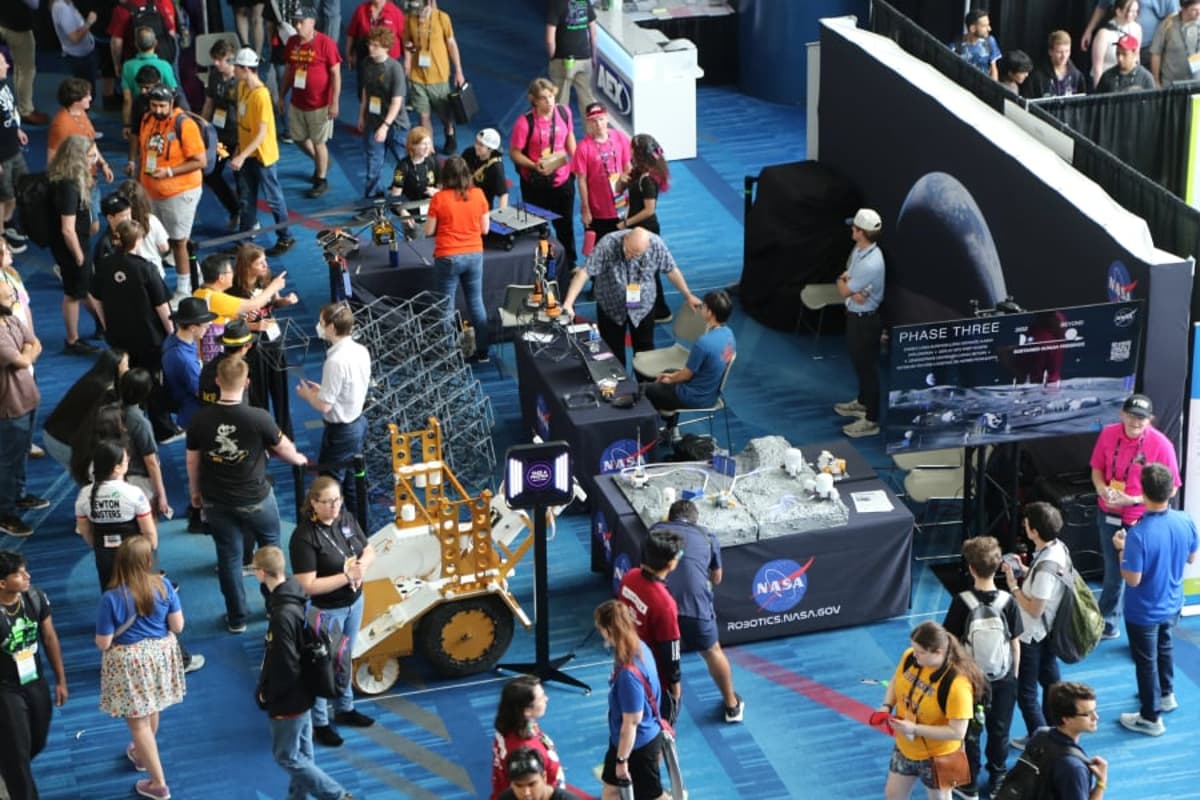
The technology roadmap extends beyond the Moon. NASA’s Skyfall Mars helicopters, inspired by the Ingenuity scout, will provide aerial reconnaissance for future crewed missions, identifying safe landing zones and optimal routes. By showcasing these systems at a high‑profile student competition, NASA also cultivates the next generation of engineers fluent in both aerospace and robotics. The convergence of autonomous construction and exploration tools promises to accelerate deep‑space ambitions while fostering a skilled workforce that can translate these innovations to commercial sectors.
NASA’s Moon Base Vision Includes Swarms of Lunar Robots
Comments
Want to join the conversation?
Loading comments...