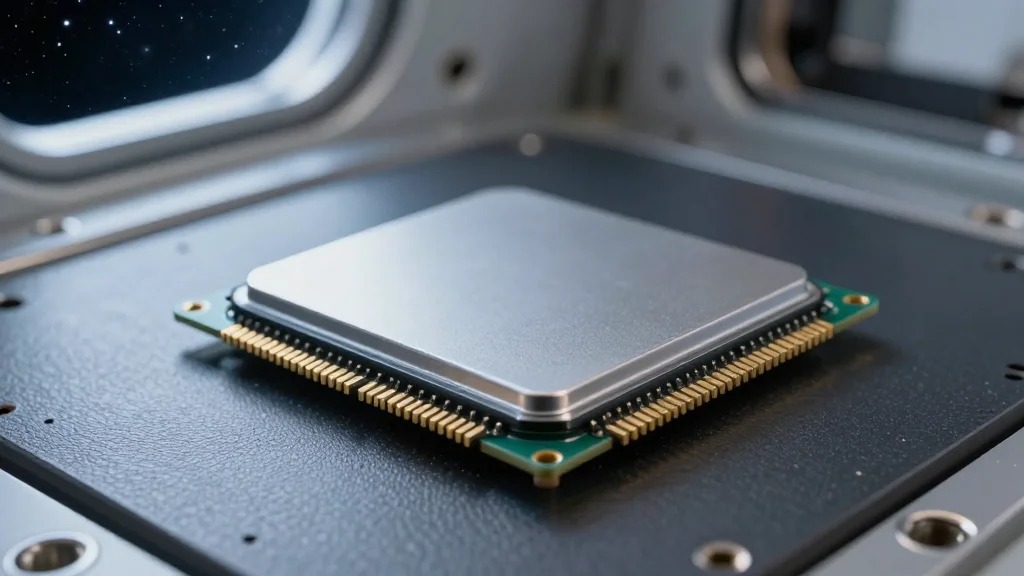
NASA's New AI Chip Promises 100‑Fold Boost for Deep‑Space Autonomy

Why It Matters
The chip represents a paradigm shift in how spacecraft handle data and respond to unexpected conditions. By embedding AI‑grade processing power directly on board, missions can reduce reliance on Earth‑based analysis, shortening the time from data collection to scientific insight. This autonomy is especially critical for deep‑space missions where communication delays can span minutes to hours, making real‑time decision‑making a matter of mission success or failure. Beyond NASA, the technology could catalyze a new market for radiation‑hard AI hardware, encouraging private firms to develop more capable lunar and Martian platforms. The ripple effect may accelerate commercial lunar infrastructure, asteroid prospecting, and even deep‑space tourism, all of which depend on reliable, high‑performance computing far from Earth’s protective magnetosphere.
Key Takeaways
- •NASA’s new processor delivers up to 100 × the computing power of current spaceflight chips.
- •Laboratory tests show performance roughly 500 × greater than existing radiation‑hardened processors.
- •The chip is radiation‑hardened, fault‑tolerant, and fits in the palm of a hand.
- •Testing began in February 2026 at JPL and will continue for several months.
- •Successful qualification could enable autonomous navigation and real‑time science on Artemis and future Mars missions.
Pulse Analysis
NASA’s AI chip arrives at a moment when the agency’s exploration roadmap is increasingly dependent on autonomy. The Artemis program’s lunar gateway and surface habitats will require spacecraft that can self‑diagnose, reroute power, and adapt to unforeseen hazards without waiting for ground commands. Historically, NASA has relied on radiation‑hard but under‑powered processors, a compromise that limited on‑board AI and forced data to be downlinked for analysis. The new chip’s 100‑fold boost narrows that gap, making sophisticated machine‑learning models feasible in situ.
From a competitive standpoint, the development mirrors a broader industry trend where defense and aerospace firms are investing in rugged AI hardware. Companies like BAE Systems and Lockheed Martin have announced similar initiatives, but NASA’s open‑science approach—leveraging commercial partnerships and publishing test results—could set a de‑facto standard. If the processor proves reliable, it may become the baseline for both government and commercial missions, driving economies of scale that lower costs for private lunar landers and deep‑space probes.
Looking ahead, the chip’s success could unlock a cascade of innovations: autonomous swarm robotics for asteroid exploration, AI‑driven life‑support monitoring on crewed Mars habitats, and even real‑time planetary geology analysis that informs landing site selection on the fly. The key risk remains the rigorous qualification process; any failure to meet radiation‑hardness thresholds could delay integration. Nonetheless, the early performance metrics suggest NASA is on track to deliver a computing platform that could redefine how humanity explores the solar system.
NASA's New AI Chip Promises 100‑Fold Boost for Deep‑Space Autonomy
Comments
Want to join the conversation?
Loading comments...