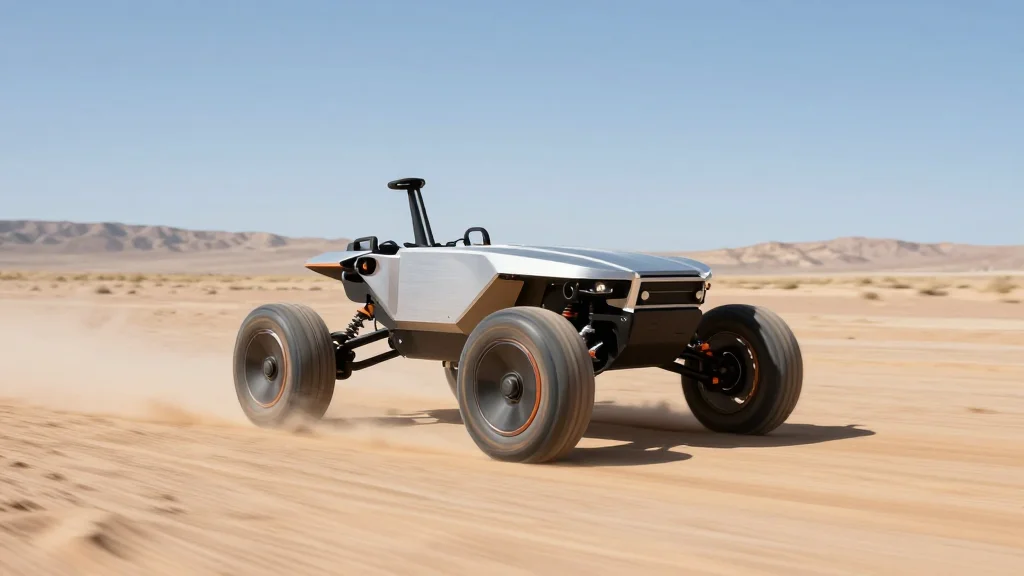
NASA’s New Rover Prototype Drove 16 Miles in a Week, 10 Times Faster than Anything It Has on Mars
Why It Matters
By dramatically increasing rover speed and terrain adaptability, ERNEST could cut mission timelines and open previously inaccessible lunar and Martian sites, enhancing scientific return and reducing operational costs.
Key Takeaways
- •ERNEST prototype drove 16 miles in 37 hours, 0.6 mph.
- •Speed ten times faster than Curiosity and Perseverance.
- •Active suspension with powered wheel joints enables obstacle‑climbing gaits.
- •Reinforcement‑learning navigation reduces reliance on Earth commands.
- •Potential lunar missions could benefit from faster, adaptable rovers.
Pulse Analysis
Planetary rovers have traditionally been built for durability, not velocity. Curiosity and Perseverance, equipped with the decades‑old rocker‑bogie suspension, top out at roughly 0.06 mph, meaning a single Martian year can yield only a few dozen meters of travel. ERNEST’s desert trial shattered that paradigm, covering 16 miles in just 37 hours at 0.6 mph—ten times the speed of its predecessors. The shift is driven by a radical suspension redesign that replaces rigid aluminum wheels with mesh tires and adds powered joints to each wheel, allowing the robot to lift, swivel, and even “squirm” over obstacles.
The mobility boost is complemented by a new decision‑making stack. JPL trained ERNEST’s navigation system in the DARTS simulation lab using reinforcement learning, exposing the algorithm to thousands of synthetic terrains before any real‑world run. This enables the rover to select wheel placements and gait transitions on the fly, sidestepping the long round‑trip communication delays that currently force Earth‑based teams to micromanage each move. An on‑board clutch also toggles between active and passive suspension, conserving energy on flat ground while delivering maximum torque when climbing steep slopes.
These capabilities open a suite of mission concepts that were previously impractical. A faster, self‑adjusting rover could traverse the permanently shadowed craters and lava tubes near the lunar south pole within the limited sunlight windows that power solar‑driven assets. Commercial partners eyeing low‑cost lunar logistics stand to benefit from reduced traversal time, translating into lower operational expenses and higher scientific payload capacity. While ERNEST remains a prototype and must still survive launch, landing and harsh extraterrestrial environments, its performance is already reshaping the conversation about next‑generation planetary exploration.
NASA’s new rover prototype drove 16 miles in a week, 10 times faster than anything it has on Mars
Comments
Want to join the conversation?
Loading comments...