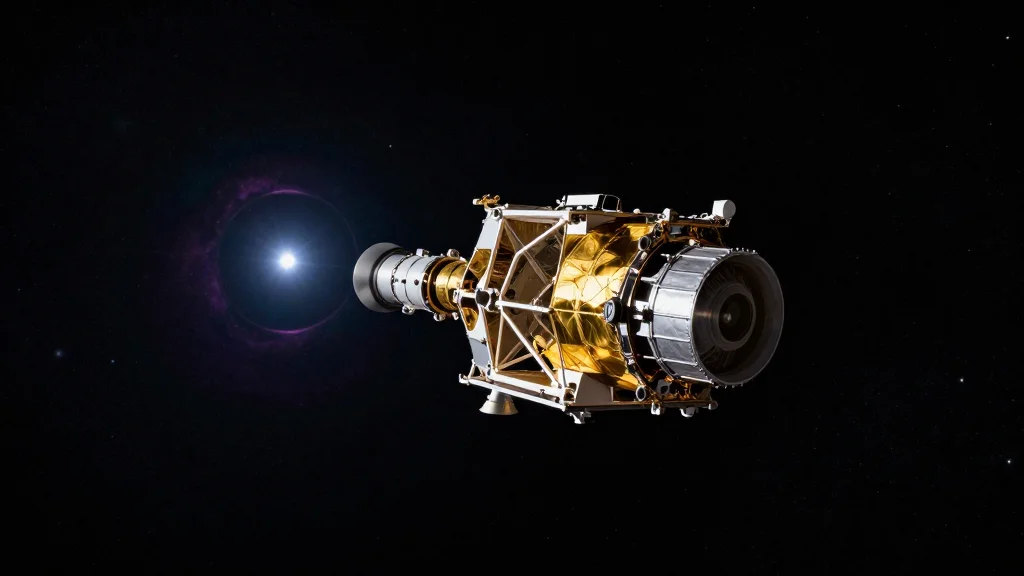
NASA’s Roman Mission Preps to Unveil New Populations of Faraway Worlds
Why It Matters
Roman’s ability to detect far‑away, low‑mass exoplanets will reshape models of planetary formation and broaden the catalog of potentially habitable worlds, while its dark‑energy observations address one of cosmology’s biggest mysteries.
Key Takeaways
- •Roman telescope to launch in 2027 for wide-field infrared surveys.
- •Microlensing survey aims to detect thousands of exoplanets beyond the snow line.
- •Expected to find Earth‑mass planets and free‑floating worlds unobservable by Kepler.
- •Mission will also map dark energy and study near‑infrared sky.
- •Data will be publicly released, enabling global research collaborations.
Pulse Analysis
The Nancy Grace Roman Space Telescope represents a leap forward in infrared astronomy, combining a field of view 100 times larger than Hubble’s with cutting‑edge detectors. Its 2027 launch will initiate a dedicated microlensing campaign that monitors millions of stars toward the Galactic bulge, a technique uniquely suited to spotting planets far from their suns. By capturing the fleeting brightening events caused by gravitational lensing, Roman can reveal planets as small as Earth and even rogue planets that wander the galaxy unattached to any star.
Scientists anticipate that Roman’s survey will add thousands of exoplanets to the known inventory, filling a critical gap left by transit missions that favor close‑in worlds. The discovery of distant, cold planets and free‑floating bodies will test prevailing theories of planet formation, migration, and the frequency of Earth‑like conditions in the outer regions of planetary systems. Moreover, the mission’s high‑resolution imaging will enable comparative studies of planetary atmospheres, offering clues about composition and potential habitability beyond the traditional habitable zone.
Beyond exoplanets, Roman’s wide‑field observations will map the large‑scale structure of the universe, providing precise measurements of dark energy’s influence on cosmic expansion. All data will be released to the public, fostering collaboration across academia, industry, and citizen‑science groups. This open‑access model not only accelerates scientific discovery but also drives innovation in data analytics, machine‑learning pipelines, and next‑generation telescope design, positioning Roman as a cornerstone for both astrophysics research and the broader space technology ecosystem.
NASA’s Roman Mission Preps to Unveil New Populations of Faraway Worlds
Comments
Want to join the conversation?
Loading comments...