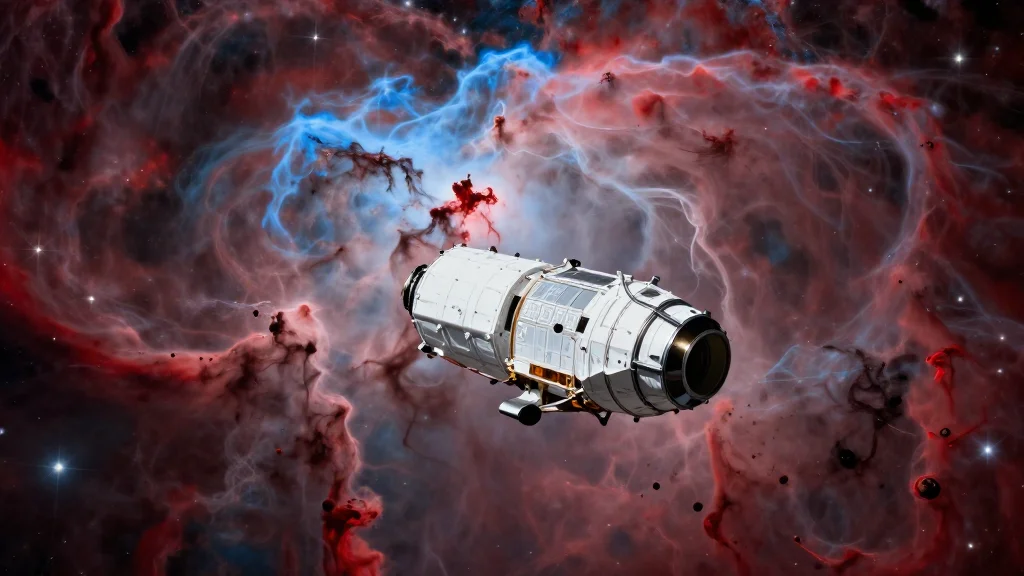
NASA’s SPHEREx Maps Water Ice Across Cygnus X Star‑Forming Complex

Why It Matters
Understanding where and how water‑ice forms in star‑forming regions directly informs theories of planetary system development and the potential for habitability. The SPHEREx map of Cygnus X provides the most comprehensive inventory of ice in a massive, turbulent environment, allowing scientists to test models that link interstellar chemistry to the delivery of water on young planets. Beyond planetary science, the findings also refine our knowledge of the Milky Way’s chemical evolution. By quantifying the relationship between dust density and ice survival, researchers can better estimate the total inventory of volatile compounds in the galaxy, a key parameter for models of galaxy formation and evolution.
Key Takeaways
- •SPHEREx produced a high‑resolution water‑ice map of the Cygnus X region, published April 15, 2026.
- •Ice concentrations align with the densest dust lanes, confirming dust‑shielding hypothesis.
- •The mission observes the sky in 102 infrared colors, uniquely suited for large‑scale ice surveys.
- •Findings suggest nascent planetary systems may inherit more water than previously thought.
- •Full‑sky SPHEREx data set, covering hundreds of millions of galaxies, will be released in early 2027.
Pulse Analysis
The SPHEREx ice map marks a turning point for large‑scale astrochemical surveys. While JWST delivers exquisite detail on individual objects, its narrow field of view limits statistical studies across the galaxy. SPHEREx bridges that gap by providing a uniform, all‑sky spectral dataset that can be cross‑referenced with JWST’s deep observations. This complementary approach is likely to become a standard workflow in the next decade, where broad surveys identify targets for high‑resolution follow‑up.
Historically, the detection of interstellar water‑ice relied on serendipitous observations of bright background stars or limited regional surveys. SPHEREx’s systematic coverage eliminates selection bias, offering a baseline for measuring how ice abundance varies with environment, metallicity, and radiation field strength. The Cygnus X results already challenge models that predict rapid ice destruction in high‑UV regions, suggesting that dust shielding is more effective than anticipated. If similar patterns emerge in other clouds, the community may need to revise timelines for ice chemistry in early planetary disks.
Looking ahead, the integration of SPHEREx data with upcoming missions such as the Nancy Grace Roman Space Telescope and the European Space Agency’s Ariel exoplanet mission could unlock a new era of comparative planetology. By linking the inventory of interstellar ices to the atmospheric compositions of exoplanets, scientists can trace the provenance of water and organics from molecular clouds to habitable worlds. The SPHEREx Cygnus X map is therefore not just a snapshot of a distant region; it is a foundational dataset that will shape our understanding of water’s cosmic journey for years to come.
NASA’s SPHEREx Maps Water Ice Across Cygnus X Star‑Forming Complex
Comments
Want to join the conversation?
Loading comments...