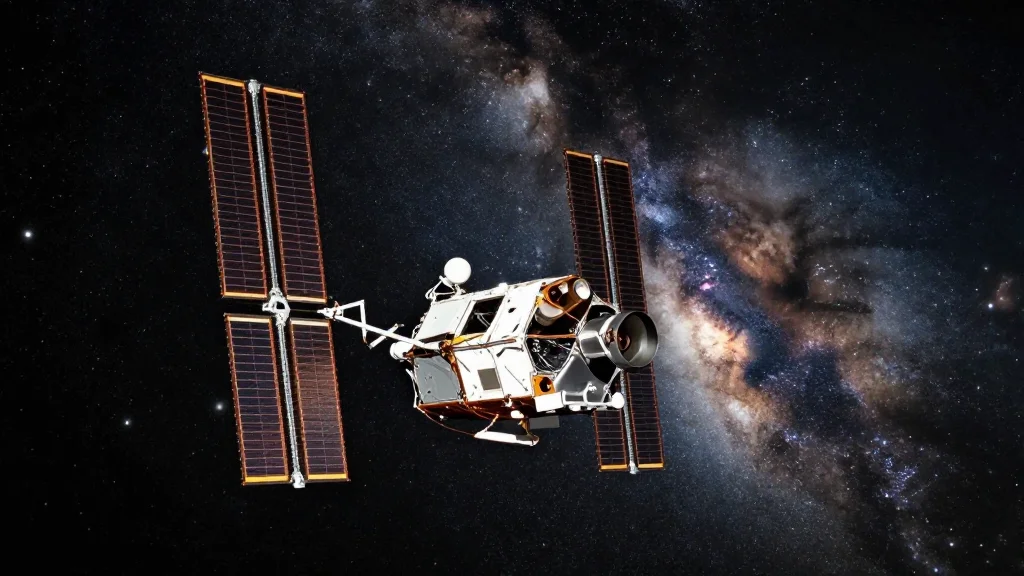
NASA’s TESS Unveils Map of 6,000 Exoplanets Across the Milky Way Plane

Why It Matters
The TESS map transforms abstract catalog numbers into a tangible galactic landscape, allowing scientists to test theories about how planet formation varies across different regions of the Milky Way. By visualising the distribution of both confirmed and candidate worlds, researchers can prioritize targets for atmospheric studies, accelerating the search for life‑supporting conditions. Moreover, the mosaic underscores the power of long‑duration, wide‑field surveys in uncovering not just planets but a host of astrophysical phenomena. The data will feed models of stellar evolution, galactic dynamics, and even near‑Earth object monitoring, making the release a multi‑disciplinary catalyst for future research.
Key Takeaways
- •NASA’s TESS released an all‑sky mosaic of ~6,000 exoplanets (700 confirmed, 5,000 candidates)
- •Map compiled from 96 observations spanning April 2018‑September 2025
- •Blue dots = confirmed planets; orange dots = candidates awaiting verification
- •The image highlights the Milky Way’s plane and includes the Large and Small Magellanic Clouds
- •Scientists cite the map as a tool to study planetary distribution, formation, and habitability
Pulse Analysis
The TESS exoplanet atlas arrives at a moment when the field is shifting from discovery to characterization. Over the past decade, the sheer volume of known worlds has outpaced the capacity to study them in detail, creating a bottleneck that the new map helps to alleviate by flagging high‑value targets for follow‑up with JWST, the upcoming ELTs, and future missions like HabEx. Historically, planet‑finding missions such as Kepler provided depth in a narrow field; TESS’s breadth now offers a statistical canvas that can be cross‑referenced with galactic structure models, potentially revealing how metallicity gradients influence planet occurrence.
From a competitive standpoint, the release reinforces NASA’s leadership in exoplanet science, especially as European and Chinese missions (e.g., PLATO and the Chinese Space Station Telescope) prepare to launch similar surveys. By publishing a visually compelling, data‑rich product, NASA not only showcases TESS’s legacy but also sets a benchmark for data transparency and public engagement. The inclusion of candidate planets—many of which will be vetted by international collaborations—promotes a collaborative ecosystem that could accelerate the identification of biosignature gases.
Looking forward, the map’s impact will be measured by how quickly the community can translate the catalog into atmospheric spectra and, ultimately, detections of life‑related chemistry. If the next wave of observations confirms a statistically significant fraction of habitable‑zone worlds with Earth‑like atmospheres, the TESS mosaic will be remembered as the turning point that turned a scattered list of exoplanets into a coherent galactic map, guiding the next generation of astrobiological exploration.
NASA’s TESS Unveils Map of 6,000 Exoplanets Across the Milky Way Plane
Comments
Want to join the conversation?
Loading comments...