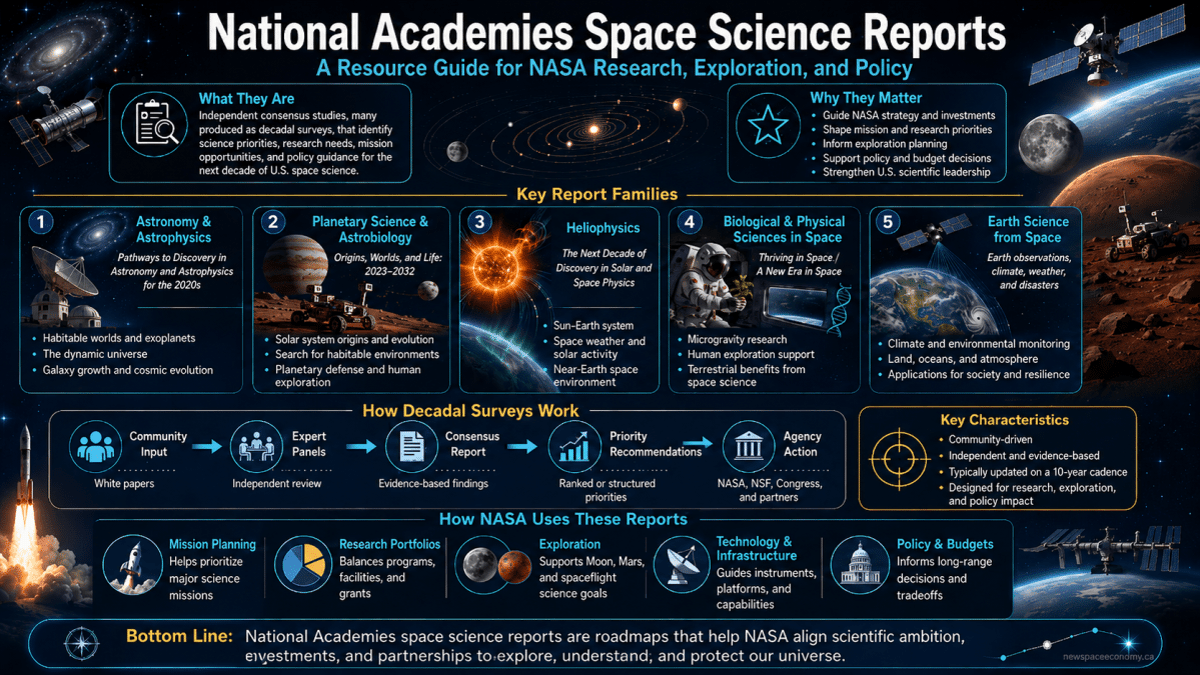
National Academies Space Science Reports: A Resource Guide for NASA Research, Exploration, and Policy
Why It Matters
The reports shape NASA’s funding and mission decisions, directly influencing the emerging space economy and national security. Understanding them enables stakeholders to align investments with long‑term U.S. space policy.
Key Takeaways
- •National Academies decadal surveys set NASA’s long‑term science priorities
- •Reports cover planetary science, astrobiology, Earth observation, and space technology
- •Guidance helps investors spot commercial opportunities aligned with NASA plans
- •Policy insights show international cooperation shaping U.S. space strategy
- •Workforce and technology gap analyses inform future talent and R&D investments
Pulse Analysis
The National Academies of Sciences, Engineering, and Medicine has long served as the intellectual backbone of U.S. space policy. Through its decadal surveys and strategic assessments, the Academy translates broad scientific ambition into concrete NASA roadmaps, defining which missions receive funding, which technologies merit development, and how research communities are organized. This systematic approach not only ensures scientific rigor but also provides a transparent framework that Congress, industry, and the public can scrutinize.
For the commercial sector, the compiled library is a treasure map. Investors and entrepreneurs can pinpoint where NASA expects breakthroughs—whether in 3D‑printing, CubeSat science, or planetary protection—allowing them to align product pipelines with upcoming contracts and policy incentives. Policymakers also gain a consolidated view of how international partnerships, such as U.S.–European collaborations, shape mission architectures, informing regulatory decisions and export‑control considerations. In short, the reports bridge the gap between academic research and market‑driven space ventures.
Looking ahead, the guide underscores persistent challenges: workforce shortages, technology gaps, and the need for sustained federal investment. By highlighting assessments of NASA’s human‑exploration workforce and technology roadmaps, the collection signals where talent pipelines and R&D funding must be bolstered to keep the United States at the forefront of space exploration. As the private sector increasingly shoulders launch and operations costs, aligning its capabilities with the Academy’s long‑term vision will be essential for a resilient, innovative space economy.
National Academies Space Science Reports: A Resource Guide for NASA Research, Exploration, and Policy
Comments
Want to join the conversation?
Loading comments...