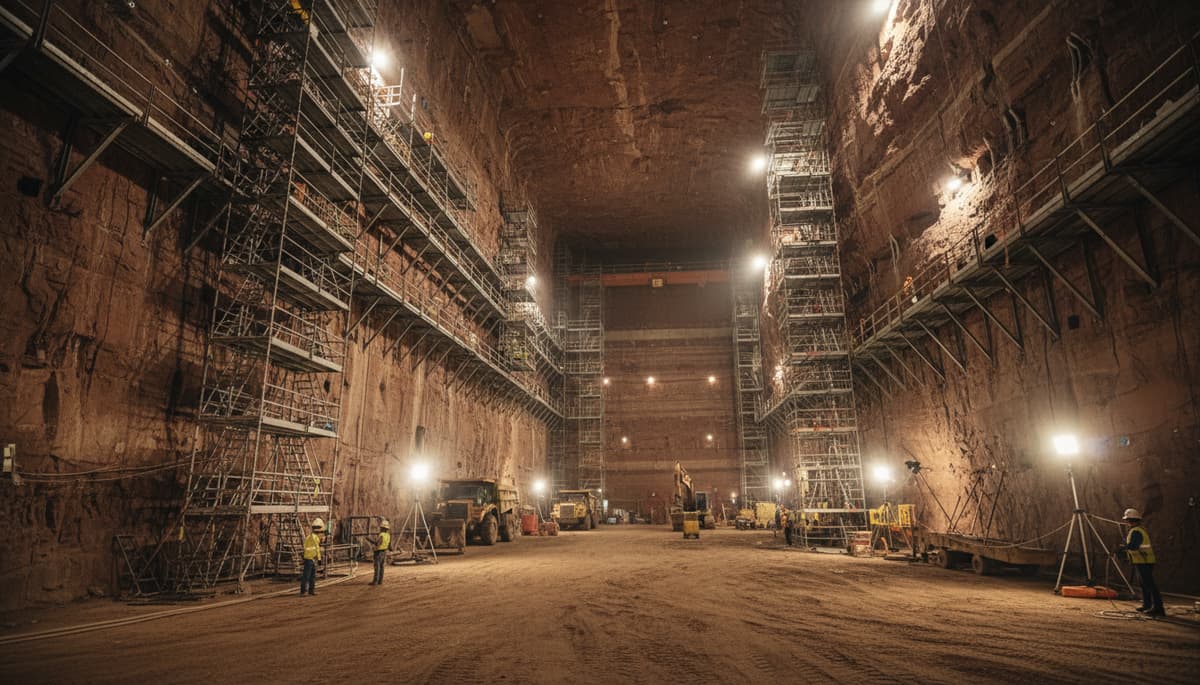
Nearly 1,600 Meters Below the Surface of South Dakota, Workers Removed 800,000 Tons of Rock and Built Two Giant Caverns without a Single Serious Accident — Inside Them, Scientists Will Install the World’s Largest Underground Cryogenic Detector
Why It Matters
The successful, accident‑free excavation enables the most ambitious neutrino detector ever built, promising breakthroughs in fundamental physics and demonstrating how legacy mining infrastructure can be repurposed for high‑tech research.
Key Takeaways
- •800,000 tons of rock removed at 1,520 m depth
- •Two caverns each 20 × 28 × 150 m host DUNE detector
- •1,135,105 hours worked without a lost‑time accident
- •DUNE will study neutrino‑antineutrino asymmetry for matter‑antimatter mystery
- •Old gold mine transformed into world‑leading particle‑physics lab
Pulse Analysis
The Sanford Underground Research Facility’s new caverns represent a milestone in underground engineering and particle physics. Removing 800,000 tons of rock at nearly 1.6 km below the surface required a blend of historic mining techniques and modern safety protocols, culminating in a flawless safety record that set a new industry benchmark. This achievement not only earned the 2026 Project of the Year award but also proved that large‑scale, deep‑earth construction can be executed without compromising worker health, a lesson applicable to future subsurface projects ranging from energy storage to data centers.
At the heart of the caverns, the Deep Underground Neutrino Experiment will install the world’s largest cryogenic detector, featuring massive liquid‑argon tanks chilled to –186 °C. By capturing the faint flashes produced when neutrinos interact with argon atoms, DUNE aims to answer why the universe favors matter over antimatter and to provide early alerts for supernova events. The detector’s unprecedented scale—spanning two chambers the size of a jumbo jet—will deliver data quality unattainable at surface labs, thanks to the natural shielding of 1,520 m of rock that blocks cosmic radiation.
Beyond scientific ambition, the project illustrates a powerful model for repurposing dormant industrial sites. The Homestake mine’s century‑long mining legacy supplied essential infrastructure—ventilation shafts, water‑pumping systems, and rock‑handling pathways—now upgraded for cutting‑edge research. This synergy reduces capital costs, shortens development timelines, and showcases how communities can transition from extractive economies to knowledge‑based hubs, potentially inspiring similar conversions of mines worldwide.
Nearly 1,600 meters below the surface of South Dakota, workers removed 800,000 tons of rock and built two giant caverns without a single serious accident — inside them, scientists will install the world’s largest underground cryogenic detector
Comments
Want to join the conversation?
Loading comments...