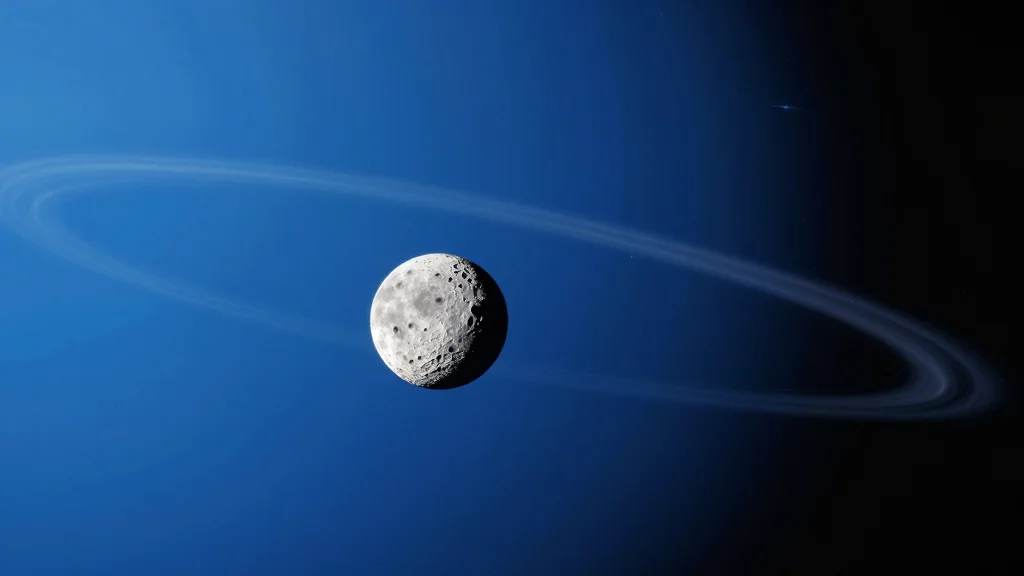
Neptune’s Moon Nereid May Be Only Intact Survivor of Ancient Giant Impact

Why It Matters
Understanding whether Nereid is a surviving relic or a captured object reshapes models of how giant planets acquire and lose satellites. If Nereid survived a massive impact, it demonstrates that early solar‑system dynamics were capable of preserving fragments of primordial moon systems, offering a tangible probe of conditions 4.5 billion years ago. The result also informs theories about the capture of Triton, a retrograde moon that likely originated in the Kuiper Belt, and how such captures can destabilize existing satellite architectures. Beyond planetary science, the study showcases the power of JWST’s infrared capabilities to differentiate moon compositions across the outer solar system, opening a new avenue for comparative planetology. As missions like Europa Clipper and the planned Neptune Orbiter advance, insights from Nereid could guide target selection and instrument design for probing other irregular moons and dwarf‑planet satellites.
Key Takeaways
- •JWST infrared observations in Nov 2024 revealed Nereid’s distinct spectral signature.
- •Dynamical simulations show a ~25% chance that pre‑existing moons survive Triton’s capture.
- •Nereid’s size (210 mi) and bright, eccentric orbit set it apart from other Neptunian moons.
- •Study published May 20 in Science Advances challenges the view that all irregular moons are captured Kuiper Belt objects.
- •Future JWST and potential Neptune Orbiter missions aim to verify Nereid’s composition and orbital stability.
Pulse Analysis
The Nereid study arrives at a moment when the outer solar system is undergoing a renaissance of high‑resolution observations. JWST’s ability to capture faint infrared signatures from distant moons is redefining how scientists classify satellite origins, moving beyond orbital dynamics to compositional fingerprints. This methodological shift could overturn long‑standing assumptions about moon capture versus in‑situ formation across all giant planets.
Historically, Triton’s retrograde orbit has been the poster child for capture events, but the new work suggests that such captures can be both destructive and preservative. The 25% survival window identified by Belyakov’s team implies that the early solar system was a chaotic arena where massive bodies could be both annihilated and spared, leaving behind rare survivors like Nereid. This nuanced view may prompt re‑examination of other irregular moons—such as Jupiter’s Himalia group or Saturn’s Phoebe—to assess whether they, too, are relics of lost satellite families.
Looking ahead, the findings set a clear agenda for the next decade: systematic infrared surveys of outer‑planet moons, coupled with high‑fidelity dynamical modeling, will become essential to map the solar system’s collisional history. If Nereid is confirmed as a survivor, it could serve as a benchmark for calibrating models of satellite disruption and retention, informing everything from the formation of exoplanetary moon systems to the design of future exploratory missions targeting the icy giants.
Neptune’s Moon Nereid May Be Only Intact Survivor of Ancient Giant Impact
Comments
Want to join the conversation?
Loading comments...