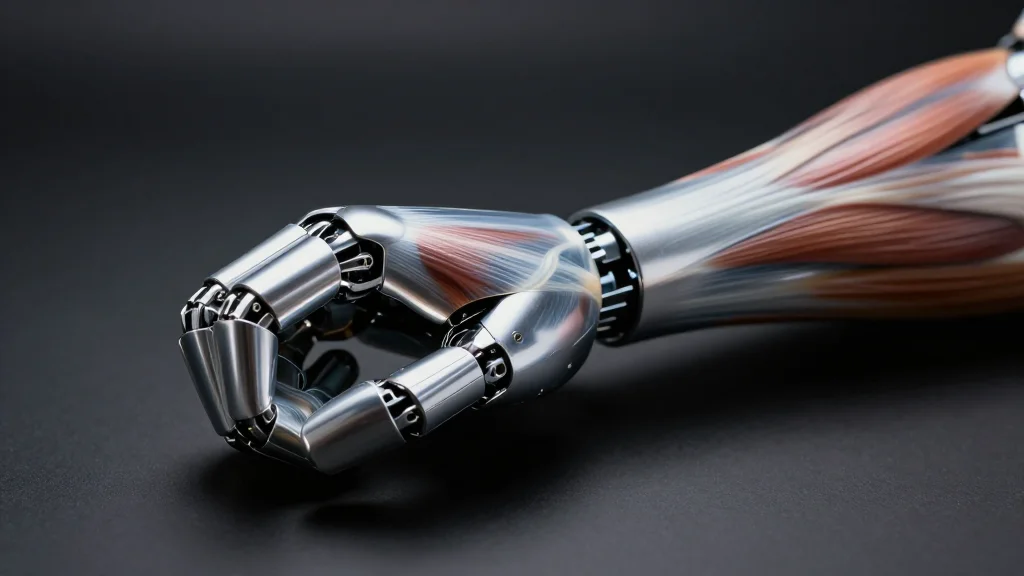
New 3D Printing Tech Is Set to Give Robots Human-Like Muscles
Why It Matters
Embedding actuation into printed material could simplify soft‑robot design and accelerate deployment in biomedical and adaptive systems, reshaping how robots interact with the physical world.
Key Takeaways
- •Harvard team 3D‑prints filaments combining active liquid crystal elastomer and passive elastomer.
- •Filament shape changes on heating, enabling bend, twist, coil without gears.
- •Rotating nozzle prints helical molecular alignment, programming motion directly into material.
- •Demonstrated soft grippers that grasp, lift, and release objects via heat.
- •Current limitation: heat activation leads to slow response and energy inefficiency.
Pulse Analysis
Soft robotics has long struggled with the trade‑off between flexibility and actuation complexity. Conventional robots rely on rigid motors, hydraulics or pneumatic artificial muscles, each demanding bulky power supplies, intricate linkages, or high voltages. The result is a mechanical architecture that, while precise, lacks the graceful, adaptive movement seen in living organisms. Engineers therefore seek materials that can both form the robot’s body and serve as its actuator, eliminating the need for separate moving parts and opening pathways to truly biomimetic designs.
Harvard’s breakthrough leverages liquid crystal elastomers—polymers that contract when heated—paired with a passive elastomer that resists that contraction. By extruding both through a rotating nozzle, the team writes helical molecular orientations directly into the filament, pre‑programming how each segment will deform. The resulting structures can expand, contract, curl or form domes simply by applying temperature changes, removing gears, joints or external compressors. This additive‑manufacturing approach enables complex, three‑dimensional actuator geometries that would be impossible to assemble using traditional components.
The implications extend beyond laboratory curiosities. Customizable, heat‑responsive filaments could power soft grippers for delicate assembly lines, shape‑shifting biomedical implants, or temperature‑adaptive architectural elements. However, the reliance on thermal activation introduces latency and energy‑use concerns that must be addressed before high‑speed or high‑power applications become viable. Ongoing research into alternative stimuli—such as light or electric fields—may overcome these hurdles, positioning 3D‑printed artificial muscles as a cornerstone of the next generation of soft, autonomous machines.
New 3D printing tech is set to give robots human-like muscles
Comments
Want to join the conversation?
Loading comments...