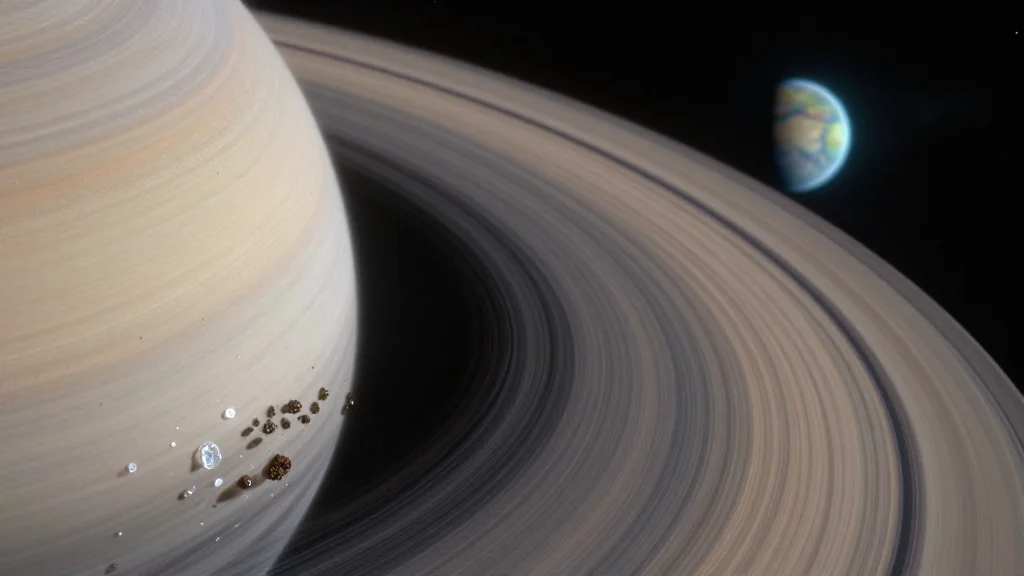
New Data From Webb Suggests Two of Uranus’ Outer Rings Are Starkly Different
Why It Matters
Understanding the divergent makeup of Uranus’s rings reshapes models of ring evolution around ice giants and informs the search for hidden moonlets or debris fields. The results also provide a comparative benchmark for interpreting ring systems of other planets, including exoplanetary disks.
Key Takeaways
- •μ ring composed of water ice from moon Mab impacts
- •ν ring contains rocky material with 10‑15% organics
- •v ring dusty, sourced from unseen parent bodies with organics
- •JWST infrared spectra unified visible‑IR data for Uranus rings
- •Findings highlight diverse ring formation mechanisms around ice giants
Pulse Analysis
The recent JWST observations of Uranus have finally bridged a gap left by decades of ground‑based and Hubble imaging. By capturing the planet’s outer rings across a continuous spectrum from visible light to the mid‑infrared, scientists could isolate a 3‑micron absorption feature common to both μ and ν rings. This spectral fingerprint, combined with laboratory analogs, confirmed that the μ ring’s particles are pristine water ice, while the ν ring’s grains are a mixture of silicates and organic tholins, a composition more typical of dusty rings elsewhere in the solar system.
The compositional split has direct implications for the dynamics of Uranus’s satellite system. The μ ring’s icy grains are now linked to the 12‑kilometer moon Mab, suggesting that micrometeoroid bombardment continuously replenishes the ring with fresh ice. In contrast, the ν ring’s rocky‑organic blend points to a separate source, likely a population of larger, yet‑undetected bodies whose collisions generate the observed dust. The v ring adds another layer of complexity, appearing dusty and organic‑rich, hinting at a cascade of collisions among hidden parent objects within the ring’s confines. Together, these findings illustrate that a single planet can host multiple, co‑existing ring formation mechanisms.
For planetary scientists, the study underscores the value of multi‑wavelength spectroscopy in unraveling the histories of ring systems. It also raises new questions about the prevalence of such compositional diversity among ice giants, a topic that will be central to upcoming missions like the Europa Clipper and potential Uranus orbiters. By establishing a detailed compositional baseline, the JWST data equips researchers to better model ring longevity, particle transport, and the role of small moons in shaping planetary environments.
New data from Webb suggests two of Uranus’ outer rings are starkly different
Comments
Want to join the conversation?
Loading comments...