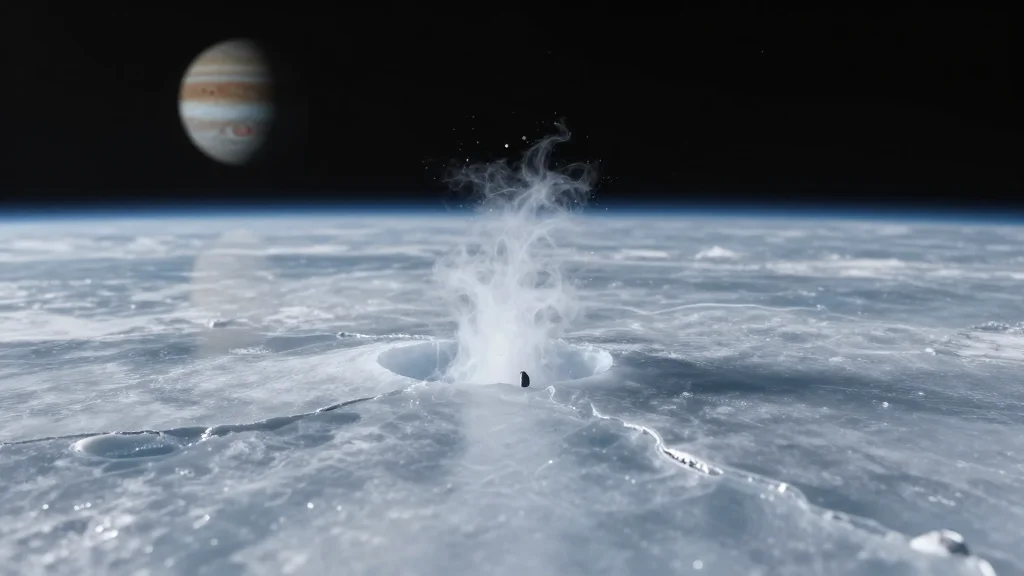
New Findings Reconsider the Existence of Europa’s Vapor Plumes
Why It Matters
Confirming or refuting Europa’s plumes directly shapes the scientific priorities and instrument design of the Europa Clipper mission, influencing how NASA allocates resources for the search for extraterrestrial life.
Key Takeaways
- •SWRI reanalysis finds no robust evidence of Europa plumes.
- •Earlier Hubble detections likely caused by imaging artifacts.
- •Detection limits now set at ~100 kg/s water vapor.
- •Future Europa Clipper instruments designed for higher sensitivity.
- •Plume uncertainty affects astrobiology and mission prioritization.
Pulse Analysis
The prospect of water‑vapor plumes on Europa has captivated planetary scientists since the first Hubble observations hinted at transient geysers in 2012. If real, such plumes could provide a direct sampling pathway to the moon’s subsurface ocean, dramatically lowering the cost and complexity of astrobiology investigations. The initial detections sparked intense debate, prompting proposals for plume‑focused flybys and influencing the early design concepts of NASA’s Europa Clipper mission.
SWRI’s latest study applied a suite of advanced de‑convolution techniques and a rigorous statistical framework to the same Hubble data set, extending the analysis through 2020. By quantifying background noise and accounting for instrument jitter, the researchers demonstrated that the previously reported brightness spikes fall within expected variability, establishing a new upper limit of about 100 kg s⁻¹ for any undetected water vapor outflow. This threshold is an order of magnitude lower than earlier estimates, suggesting that if plumes exist, they are either far weaker or far less frequent than originally thought.
The revised findings carry immediate implications for Europa Clipper, which will carry a high‑resolution mass spectrometer and ice‑penetrating radar. With plume activity now considered uncertain, mission planners are emphasizing comprehensive surface and subsurface surveys rather than relying on opportunistic plume sampling. Nonetheless, the possibility of episodic eruptions remains, keeping the scientific community attentive to future observations from ground‑based telescopes and the upcoming James Webb Space Telescope. Clarifying Europa’s plume status will sharpen the focus on habitability assessments and guide the allocation of billions of dollars in planetary exploration budgets.
New Findings Reconsider the Existence of Europa’s Vapor Plumes
Comments
Want to join the conversation?
Loading comments...