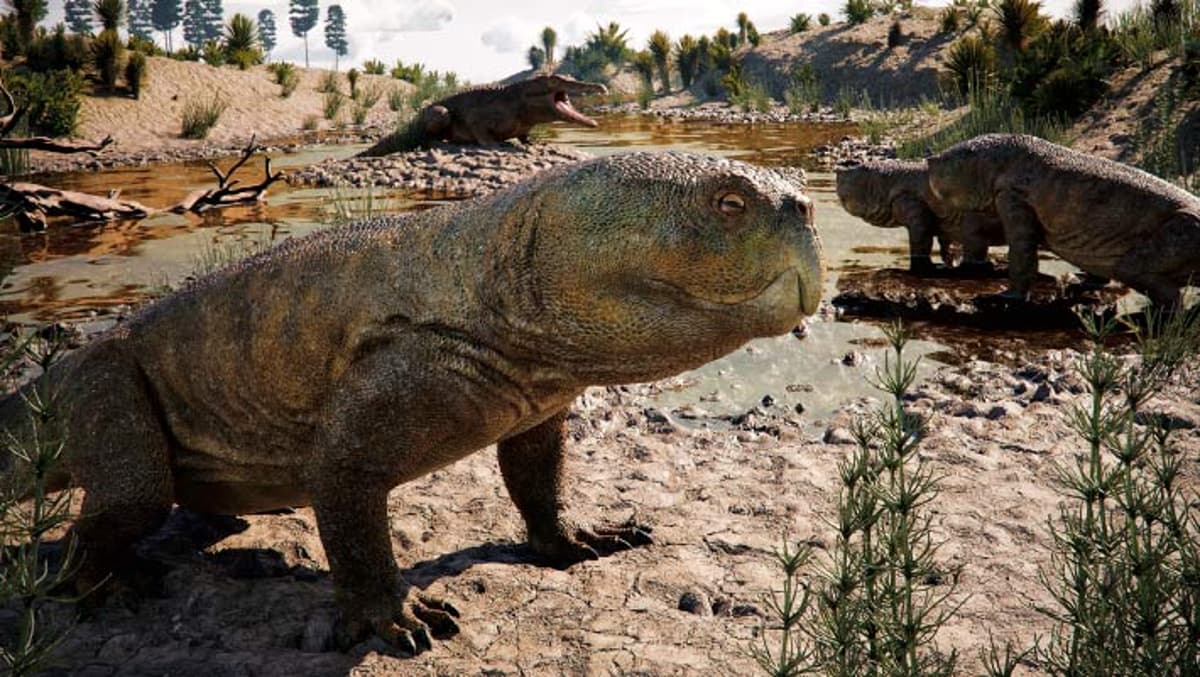
New Fossil From Brazil Reveals Unexpected Diversity Among Pre-Dinosaur Herbivores
Why It Matters
The discovery reshapes our understanding of rhynchosaur evolution, revealing a more complex herbivore guild in the Late Triassic and refining biostratigraphic frameworks used to date continental deposits.
Key Takeaways
- •New genus Isodapedon varzealis identified from 230‑million‑year‑old Brazilian fossils.
- •Symmetrical tooth‑bearing maxilla suggests distinct feeding strategy among rhynchosaurs.
- •Phylogeny places species outside known South American hyperodapedontines, redefining genus Hyperodapedon.
- •Findings reveal greater rhynchosaur diversity and niche partitioning during Carnian Pluvial Episode.
- •Rhynchosaurs act as biostratigraphic markers, comprising up to 90% of some fossils.
Pulse Analysis
Rhynchosaurs were the premier herbivores of the Middle and Late Triassic, occupying a vast range across Pangea. Their beaked skulls and rows of grinding teeth allowed them to process tough vegetation, making them a cornerstone of terrestrial ecosystems and a reliable biostratigraphic indicator in sedimentary sequences. The new Brazilian specimen adds a fresh data point to this well‑documented clade, highlighting how even well‑studied groups can still yield surprises.
Isodapedon varzealis, recovered from the Várzea do Agudo locality in Rio Grande do Sul, displays a symmetrical maxillary tooth plate and a distinctive dentary configuration. These features set it apart from the classic Hyperodapedon morphology and suggest a divergent feeding niche, possibly exploiting plant resources unavailable to its relatives. The authors' phylogenetic analysis pushes the species outside the established South American hyperodapedontine branch, prompting a tighter taxonomic definition of Hyperodapedon and expanding the hyperodapedontine radiation across southwestern Gondwana.
The broader implication is a more nuanced picture of Late Triassic herbivore dynamics. The Carnian Pluvial Episode triggered major climatic shifts, and the emergence of taxa like Isodapedon indicates niche partitioning that could have buffered ecosystems against environmental stress. For paleontologists and stratigraphers, this discovery refines correlation tools, as rhynchosaurs often dominate fossil assemblages, sometimes comprising up to 90% of vertebrate remains. Future fieldwork in Gondwanan basins may uncover additional lineages, further illuminating the evolutionary pathways that set the stage for the rise of dinosaurs.
New Fossil from Brazil Reveals Unexpected Diversity among Pre-Dinosaur Herbivores
Comments
Want to join the conversation?
Loading comments...