New Fundamental Physics Measurement Deepens Quantum Mystery
Why It Matters
By reaffirming the Standard Model’s prediction for the W boson, the CMS result reduces pressure for new physics explanations that the earlier CDF outlier implied. It also highlights the need for even more precise measurements to uncover any subtle cracks in the theory.
Key Takeaways
- •CMS measures W boson at 80,360.2 ± 9.9 MeV.
- •Result agrees with Standard Model, contrary to 2022 CDF anomaly.
- •Measurement uses muon decay channel from ~100 million collisions.
- •Precision rivals CDF’s, but only one of six analysis methods.
- •Confirms need for further high‑precision studies to probe beyond Standard Model.
Pulse Analysis
The W boson, a carrier of the weak nuclear force, sits near the top of the particle mass hierarchy at roughly 80 GeV. Its mass is a critical parameter for testing the internal consistency of the Standard Model, because quantum corrections tie it to the masses of the top quark and the Higgs boson. In 2022, the CDF collaboration at Fermilab reported a W‑boson mass 80,433 MeV—about 80 MeV higher than the Standard Model expectation—sparking intense speculation that the deviation could signal new particles or forces. The result, however, stood alone, and the particle‑physics community has been awaiting an independent verification.
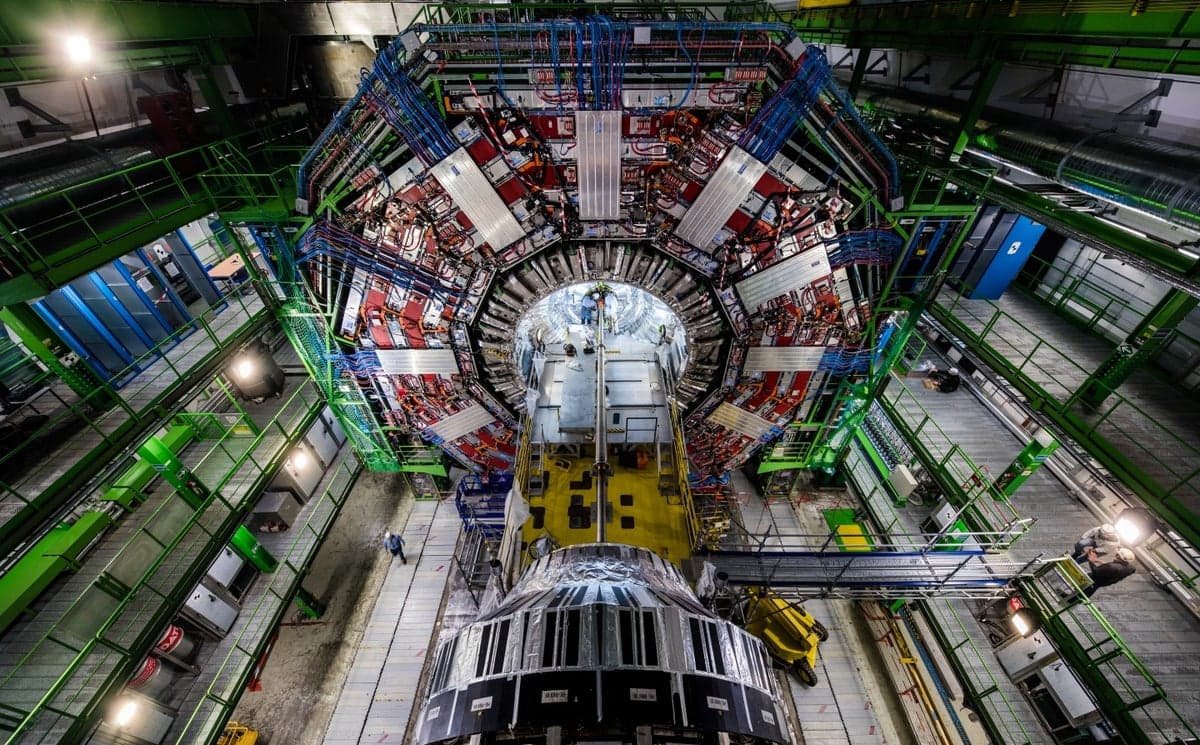
The Compact Muon Solenoid (CMS) experiment at CERN’s Large Hadron Collider has now delivered a measurement of 80,360.2 ± 9.9 MeV, derived from roughly 100 million proton‑proton collisions that produced W bosons decaying into muons and neutrinos. By exploiting the detector’s superb muon momentum resolution and a sophisticated fit to the transverse mass spectrum, the team achieved a precision comparable to the CDF analysis while relying on a single decay channel. Crucially, the CMS value sits squarely within the Standard Model prediction, effectively neutralizing the earlier anomaly and reinforcing the model’s robustness.
While the new result restores confidence in the prevailing theory, it also underscores how narrow the window for discovering physics beyond the Standard Model has become. Future runs of the LHC, along with planned high‑luminosity upgrades, aim to shrink the W‑boson uncertainty below five MeV, a regime where even subtle deviations could reveal hidden sectors such as dark matter candidates or additional Higgs‑like particles. In parallel, complementary experiments—like the proposed electron‑positron colliders—will provide independent cross‑checks, ensuring that any lingering tension is either resolved or amplified into a genuine breakthrough.
New fundamental physics measurement deepens quantum mystery
Comments
Want to join the conversation?
Loading comments...