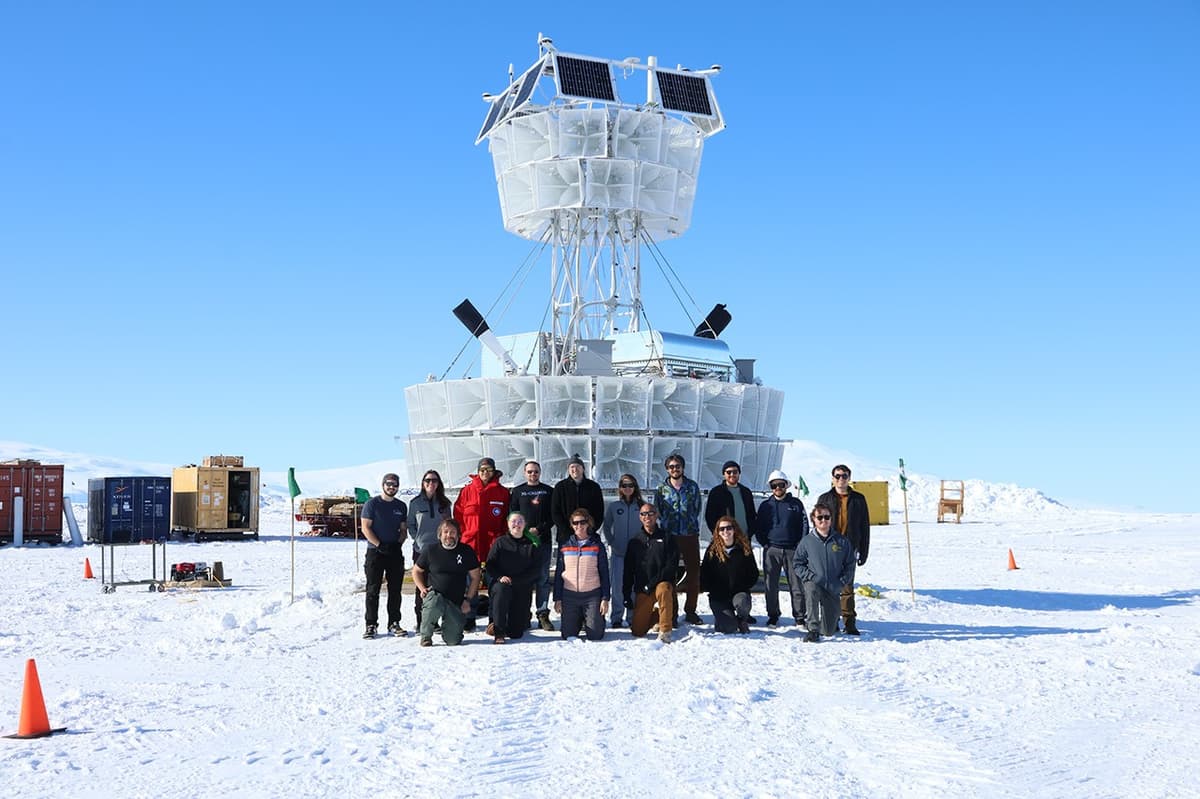
New Instrument Used Antarctic Ice Sheet to Probe Extreme Universe
Why It Matters
PUEO’s enhanced detection capability opens a new window on the most energetic astrophysical phenomena, informing both cosmic‑ray origin theories and fundamental physics beyond accelerator limits. Its technology roadmap could accelerate next‑generation ultra‑high‑energy observatories on the Moon or elsewhere.
Key Takeaways
- •PUEO flew 23 days from Antarctica, covering 120,000‑ft altitude.
- •Interferometric phased‑array trigger lowered detection threshold for weak neutrino signals.
- •Antenna collecting area above 300 MHz doubled, boosting radio sensitivity.
- •New low‑frequency module (50 MHz) added air‑shower detection capability.
- •Technology may enable future lunar regolith ultra‑high‑energy particle detectors.
Pulse Analysis
Ultra‑high‑energy neutrinos are the universe’s most elusive messengers, traveling straight from cataclysmic sources such as supermassive black holes and neutron‑star mergers. Because they interact only rarely with matter, detecting them requires enormous target volumes. PUEO leveraged the Antarctic ice sheet—an effectively limitless detector—by lofting a radio‑frequency array on a long‑duration balloon, turning the continent into a giant neutrino observatory and offering a direct view of the most extreme astrophysical accelerators.
The mission’s breakthrough lies in its hardware innovations. An interferometric phased‑array trigger coherently summed signals from dozens of antennas in real time, pushing the detection threshold lower than any prior balloon experiment. Coupled with a doubled antenna collecting area above 300 MHz and a compact low‑frequency module extending sensitivity down to 50 MHz, PUEO captured both deep‑ice neutrino interactions and atmospheric air‑shower radio bursts. These advances not only improve event rates but also refine directional reconstruction, critical for pinpointing cosmic origins.
Beyond the immediate science, PUEO’s legacy is strategic. The recovered data set, slated for a year‑long analysis, will test models of ultra‑high‑energy particle production and probe physics at energies unattainable on Earth. Moreover, the instrument’s modular, volume‑efficient design informs upcoming concepts that aim to use lunar regolith as a detector medium, potentially expanding the observational horizon to the Moon’s far side. As NASA’s first Astrophysics Pioneers mission, PUEO demonstrates how cost‑effective balloon platforms can deliver cutting‑edge astrophysics, setting the stage for a new generation of high‑energy cosmic observatories.
New Instrument Used Antarctic Ice Sheet to Probe Extreme Universe
Comments
Want to join the conversation?
Loading comments...