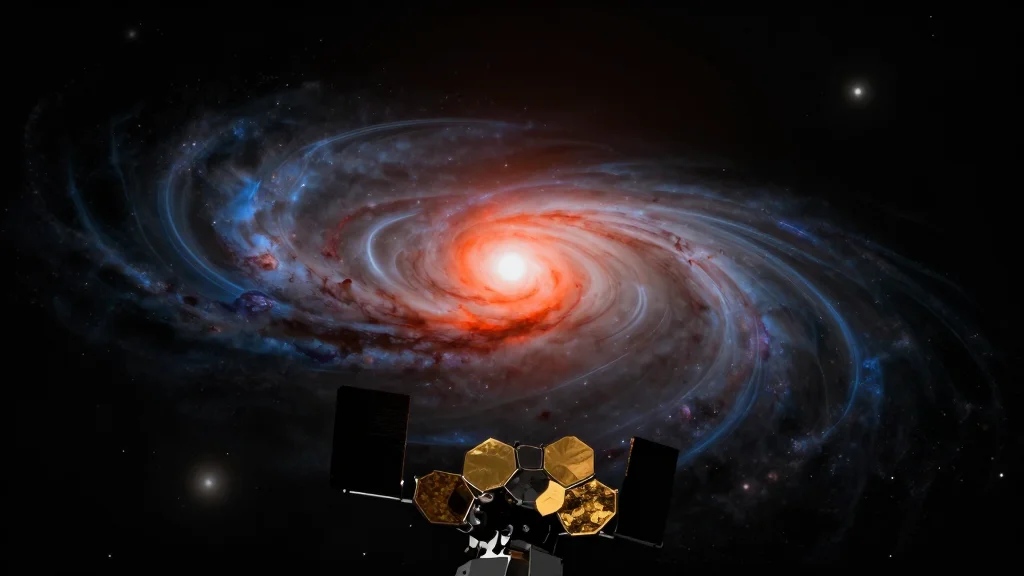
New JWST Images of Abnormally Well-Developed Galaxy Cluster Open up the 'Cosmic Noon' Frontier
Why It Matters
The discovery provides a rare, direct probe of dark‑matter distribution and challenges standard models of early‑universe structure formation, potentially reshaping cosmological theory.
Key Takeaways
- •XLSSC 122 sets record as most distant strong‑lensing galaxy cluster
- •Cluster’s concentrated core challenges standard cosmological formation timelines
- •JWST’s high‑resolution imaging reveals intracluster light at cosmic noon
- •Strong lensing provides direct dark‑matter map without visible matter
- •Future wide‑field X‑ray and SZ surveys aim to find similar clusters
Pulse Analysis
James Webb’s unprecedented infrared sensitivity has turned the distant cluster XLSSC 122 into a natural telescope, magnifying even farther galaxies into striking arcs. By capturing these strong‑lensing features, scientists can weigh the cluster’s core with a precision previously reserved for nearby systems, exposing a mass concentration that rivals modern clusters despite forming when the universe was only a few billion years old. This breakthrough showcases JWST’s ability to resolve fine structures at cosmic noon, opening a new window onto the early growth of massive halos.
Beyond the visual spectacle, the lensing data serve as a direct tracer of dark matter, the invisible scaffolding that underpins galaxy formation. The measured dark‑matter profile in XLSSC 122 aligns with the bright intracluster light, suggesting that stellar debris can map unseen mass even in nascent environments. Such a correspondence challenges prevailing simulations that predict a slower assembly of dense cores, prompting theorists to revisit assumptions about dark‑matter behavior and baryonic feedback during the universe’s peak star‑formation period.
Looking ahead, the rarity of strong‑lensing clusters at high redshift means that wide‑area surveys—particularly X‑ray, radio, and Sunyaev–Zel’dovich observations—will be essential for identifying more candidates. As JWST continues to target these objects, a statistical sample could decisively test whether XLSSC 122 is an outlier or a sign of a broader, previously hidden population. The resulting data will refine cosmological parameters and may compel a revision of the timeline for large‑scale structure emergence.
New JWST images of abnormally well-developed galaxy cluster open up the 'cosmic noon' frontier
Comments
Want to join the conversation?
Loading comments...