New Space Telescope Will Map Galaxies’ Ghostly Halos and Streams
Why It Matters
Understanding stellar halos and streams directly informs galaxy‑formation theory and offers a novel way to map dark‑matter distribution, impacting both astrophysics and cosmology. The data will provide a statistical baseline that could reshape models of how large galaxies assemble over cosmic time.
Key Takeaways
- •ARRAKIHS costs €320 million (~$350 million) as ESA’s F‑class mission.
- •Will map halos and streams around ~80 Milky Way‑like galaxies.
- •Targets galaxies 50‑130 million light‑years distant for deep imaging.
- •Data will test galaxy formation models and dark‑matter distribution.
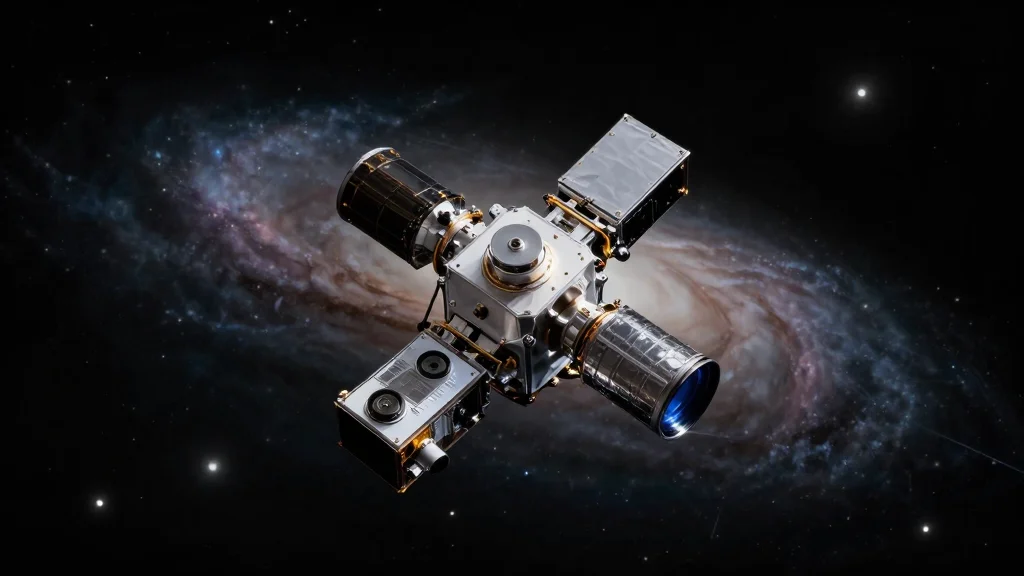
- •Four telescopes operate UV, visible, and near‑IR with long exposures.
Pulse Analysis
The ARRAKIHS mission marks a strategic leap for ESA, combining modest budget with cutting‑edge instrumentation to tackle one of astronomy’s most elusive targets: the faint outskirts of galaxies. While previous surveys have identified stellar streams in the Milky Way and a few nearby systems, ARRAKIHS will expand the sample size dramatically, delivering uniform, high‑resolution maps of halos around dozens of external galaxies. This breadth enables researchers to move beyond case studies and assess the statistical prevalence of merger‑driven growth, a cornerstone of hierarchical cosmology.
Beyond reconstructing merger histories, ARRAKIHS offers a powerful probe of dark matter. The curvature and thickness of stellar streams trace the underlying gravitational potential, allowing astronomers to infer the shape and clumpiness of dark‑matter halos far beyond what traditional rotation‑curve measurements provide. By comparing stream morphologies across a diverse galaxy set, scientists can test competing dark‑matter models, from cold particle scenarios to more exotic self‑interacting variants. The mission’s multi‑band approach—spanning near‑ultraviolet to near‑infrared—ensures sensitivity to both old, metal‑poor stars and younger populations, enriching the dynamical picture.
The broader impact of ARRAKIHS extends to the next generation of space observatories. Its fast‑track development timeline demonstrates how focused, cost‑effective missions can deliver high‑impact science, informing the design of future flagship telescopes such as the European Extremely Large Telescope’s space‑based counterparts. Moreover, the public release of a comprehensive halo‑stream catalog will empower the global research community, fostering collaborations that could accelerate breakthroughs in galaxy evolution, dark‑matter physics, and cosmological modeling. As the launch window approaches, anticipation builds for a dataset that may finally answer whether our Milky Way is a cosmic norm or an outlier.
New space telescope will map galaxies’ ghostly halos and streams
Comments
Want to join the conversation?
Loading comments...