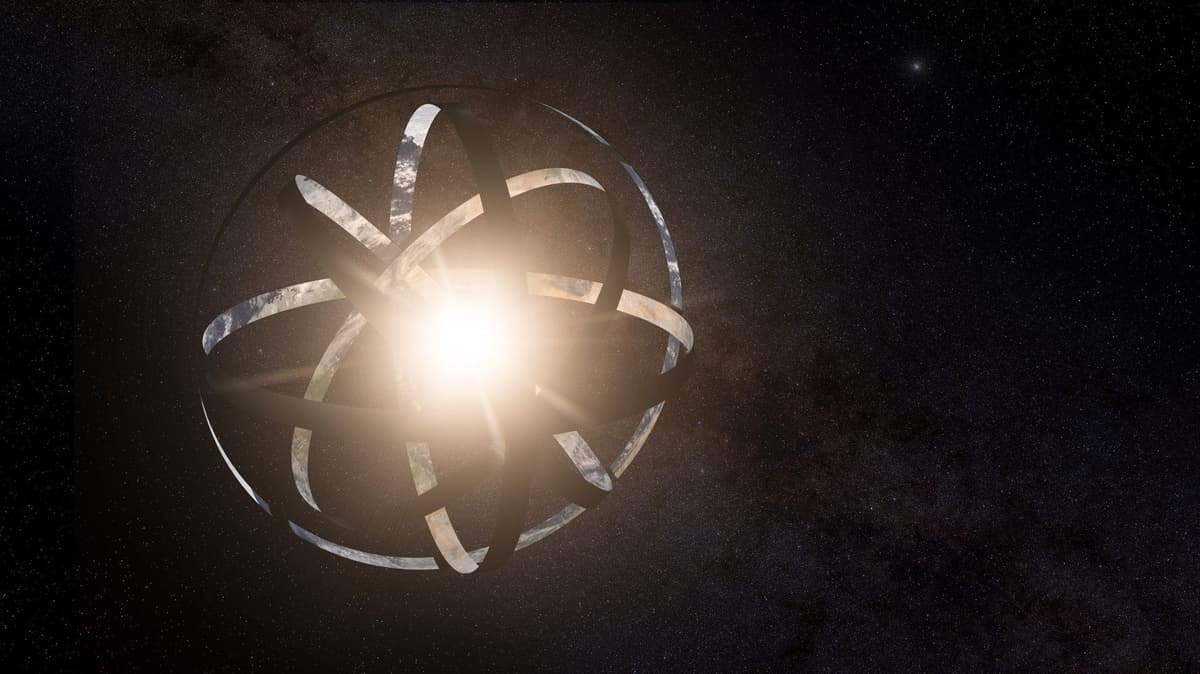
New Study Says There's a Way to Make Dyson Bubbles and Stellar Engines Stable
•March 11, 2026
0
Why It Matters
Stable megastructures provide realistic targets for SETI and demonstrate plausible pathways for advanced civilizations to harness stellar energy, reshaping expectations of extraterrestrial technosignatures.
Key Takeaways
- •Passive stability achievable via edge‑mass concentration
- •Dyson Bubbles could produce distinct, static technosignatures
- •Stellar Engines balance radiation pressure and gravity for propulsion
- •Study refines SETI search parameters for megastructures
- •Simplified model highlights need for further engineering analysis
Pulse Analysis
The idea of enclosing a star in a colossal energy‑collecting shell has moved from speculative fiction to serious astrophysical inquiry since Freeman Dyson first outlined it in 1960. Recent anomalies such as the irregular dimming of Boyajian’s Star have revived public and scientific fascination, prompting researchers to catalog a family of ‘Dyson structures’ ranging from swarms of mirrors to solid shells. While the sheer scale of these megastructures raises daunting engineering questions, the primary obstacle has long been their inherent gravitational instability.
In a new paper published in *Monthly Notices of the Royal Astronomical Society*, Professor Colin R. McInnes demonstrates that two prominent designs—a Dyson Bubble and a flat‑disk Stellar Engine—can achieve passive stability without continuous active control. By concentrating mass at the rim of a reflective disc, the gravitational pull and radiation pressure can be balanced, allowing the structure to remain centered on its star. A similarly configured Dyson Bubble, with elements arranged so that light pressure declines faster than gravity outward, self‑stabilizes and avoids internal collisions. These findings provide concrete engineering pathways that were previously only theoretical.
The stability criteria outlined by McInnes have immediate implications for the Search for Extraterrestrial Intelligence. A self‑stabilizing Dyson Bubble would manifest as a static, dense cloud altering a star’s spectrum, while a passive Stellar Engine would scatter light in a predictable pattern, both offering distinct technosignatures for telescopic surveys. Although the model simplifies material properties and ignores perturbations, it establishes a baseline for refining detection algorithms and prioritizing observational targets. Future work will need to incorporate realistic dynamics, but the study marks a pivotal step toward turning megastructure speculation into testable astrophysical hypotheses.
New Study Says There's a Way to Make Dyson Bubbles and Stellar Engines Stable
0
Comments
Want to join the conversation?
Loading comments...