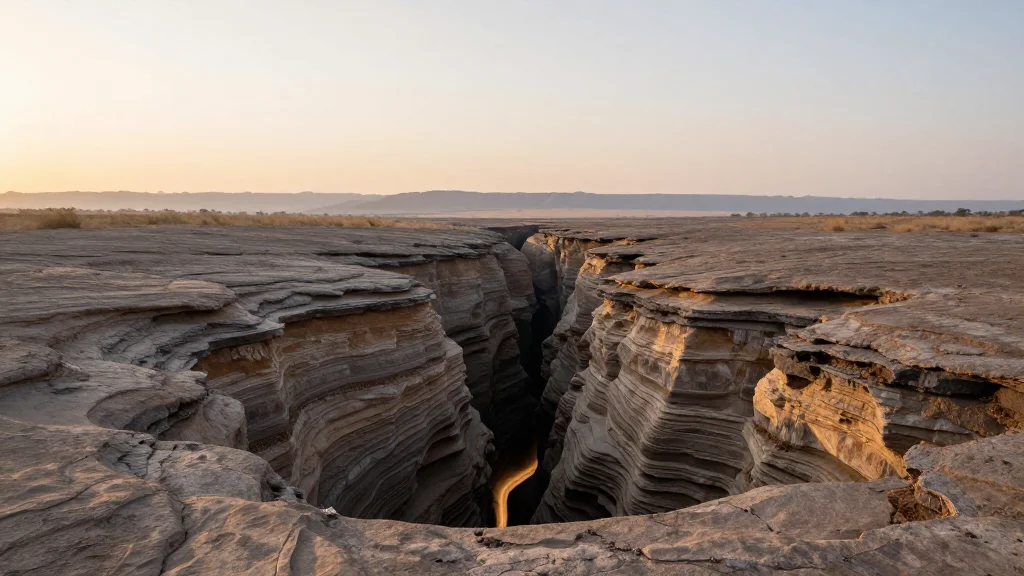
New Study Shows Africa's Turkana Rift Thinning to Critical 13 Km, Accelerating Continental Breakup

Why It Matters
The accelerated thinning of the Turkana Rift reshapes scientific expectations for Africa’s tectonic future, suggesting a faster timeline for continental fragmentation and the eventual formation of a new ocean basin. This has profound implications for geohazard assessment, resource exploration, and climate modeling, as rift dynamics influence regional uplift, volcanic activity, and sediment transport. Equally significant, the study bridges geology and paleoanthropology by linking the mechanical processes that split continents to the exceptional preservation of early human fossils. Understanding this connection could guide future excavations, helping researchers target areas where tectonic activity has historically created natural archives of our evolutionary history.
Key Takeaways
- •Crust under Turkana Rift thinned to ~13 km, versus >35 km away, indicating advanced necking.
- •Plate separation measured at 4.7 mm per year, accelerating continental rift progression.
- •Findings published in *Nature Communications* highlight faster African fragmentation than models predicted.
- •Study links rift dynamics to the rich fossil record, offering a new explanation for preservation.
- •Future work will expand seismic surveys and satellite monitoring to track ongoing deformation.
Pulse Analysis
The Turkana Rift discovery marks a watershed for plate‑tectonic research, challenging the conventional view that Africa’s breakup is a slow, millennial process. By quantifying crustal thinning to a critical 13 km, the Columbia team provides concrete evidence that the rift has entered a late‑stage necking phase, a condition previously inferred only from indirect surface observations. This refinement forces a recalibration of global tectonic models, which must now accommodate a more rapid divergence rate for the African and Somali plates.
Historically, East African rifting has been a laboratory for studying continental breakup, yet the new data suggest that the timeline for oceanic basin formation could be compressed by several million years. Such a shift has downstream effects on climate projections, as the emergence of a new ocean would alter atmospheric circulation patterns and heat distribution across the Southern Hemisphere. Moreover, the heightened volcanic and seismic activity associated with accelerated rifting raises immediate concerns for infrastructure and livelihoods in Kenya and Ethiopia, underscoring the need for integrated hazard mitigation strategies.
From a paleoanthropological standpoint, the study offers a mechanistic explanation for the concentration of hominin fossils in the Turkana Basin. The same extensional forces that thin the crust also generate basins that trap sediments and preserve organic material. This insight could steer future fieldwork toward other under‑explored rift segments where similar necking may have occurred, potentially unlocking new chapters of human evolution. In sum, the research not only redefines the pace of Africa’s geological destiny but also enriches our understanding of how Earth’s dynamic interior shapes the story of life on its surface.
New Study Shows Africa's Turkana Rift Thinning to Critical 13 km, Accelerating Continental Breakup
Comments
Want to join the conversation?
Loading comments...