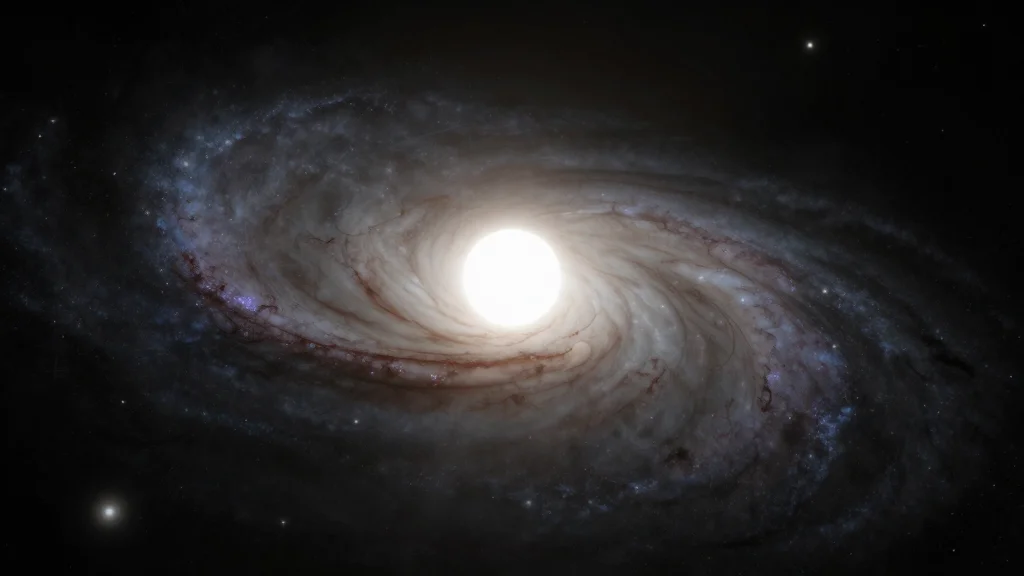
New Study Shows How a Single Star Can Reshape an Entire Galaxy
Why It Matters
The discovery links individual stellar events to galaxy‑scale transformation, forcing a rethink of how models predict galaxy growth and morphology. It provides a missing piece for understanding early‑universe galaxy formation where massive stars were abundant.
Key Takeaways
- •Star >100 solar masses injects 10^51 ergs into surrounding gas
- •Simulations reveal bubble expanding over 5,000 light‑years
- •Feedback reshapes dwarf galaxy morphology within 10 million years
- •Findings challenge assumption that only collective supernovae drive galactic change
- •Implications extend to modeling early‑universe galaxy formation
Pulse Analysis
Stellar feedback has long been recognized as a key driver of galactic evolution, but most models treat it as a collective effect of many supernovae. The Leiden study flips that paradigm by isolating the influence of a single, ultra‑massive star. Using state‑of‑the‑art hydrodynamic simulations, the team tracked how the star’s radiation pressure, stellar winds, and final supernova explosion injected energy comparable to an entire star cluster, inflating a cavity that spanned several kiloparsecs. Observations of a nearby dwarf galaxy confirmed the simulated bubble’s size and its impact on surrounding gas clouds.
The researchers measured the star’s output at roughly 10^51 ergs—energy typically associated with dozens of supernovae. This infusion of momentum reshaped the galaxy’s interstellar medium, compressing gas in some regions while evacuating it in others, thereby triggering a burst of secondary star formation. Crucially, the transformation occurred on a timescale of about ten million years, a blink in cosmic terms, suggesting that individual massive stars can act as catalysts for rapid morphological change.
These findings have far‑reaching implications for cosmology and computational astrophysics. Galaxy formation simulations will need to incorporate stochastic, high‑impact stellar events rather than averaging them out, especially when modeling the early universe where massive Population III stars were common. The study also opens new avenues for interpreting observations from next‑generation telescopes, such as the James Webb Space Telescope, which can now search for similar feedback signatures in distant, primordial galaxies. By bridging the micro‑scale physics of a single star with macro‑scale galactic outcomes, the research sharpens our predictive tools for the cosmos.
New Study Shows How a Single Star Can Reshape an Entire Galaxy
Comments
Want to join the conversation?
Loading comments...