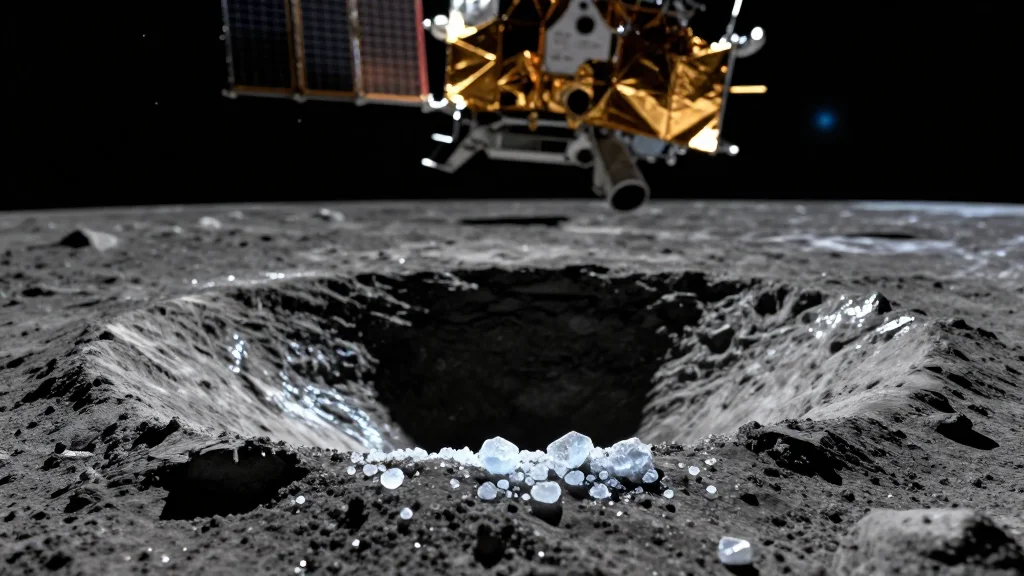
New Study Using Chandrayaan-2 Data Again Suggests Ice in Crater Near Moon’s South Pole
Why It Matters
Confirming subsurface ice near the lunar south pole strengthens the case for in‑situ resource utilization, a critical enabler for sustainable lunar habitats and commercial mining ventures. It also signals to space agencies and private firms that extraction technology, not just detection, will be the next strategic focus.
Key Takeaways
- •Chandrayaan-2 DFSAR detects subsurface ice in Faustini crater.
- •Ice signature found in 1.1‑km crater inside Faustini basin.
- •Lobate rim morphology suggests ice‑rich, mud‑like material.
- •Findings reinforce need for extraction technology for lunar ice.
- •Multiple missions now converge on water ice presence at south pole.
Pulse Analysis
The quest for lunar water has accelerated over the past decade, with orbiters, landers, and telescopes all hunting for the elusive ice that could fuel future exploration. Chandrayaan‑2’s Dual Frequency Synthetic Aperture Radar, originally designed for high‑resolution mapping, offers a unique advantage: its microwave wavelengths can penetrate the Moon’s permanently shadowed regions and reveal dielectric contrasts indicative of ice. Earlier studies from NASA’s Lunar Reconnaissance Orbiter and the Indian Space Research Organisation’s own Chandrayaan‑1 hinted at ice deposits, but the new analysis sharpens the picture by focusing on a specific 1.1‑km crater within Faustini, where radar backscatter and surface morphology converge.
The crux of the discovery lies in the crater’s lobate‑rim shape, a flow‑like pattern that researchers interpret as evidence of an impact that sliced through an ice‑laden substrate. Such morphology, combined with the radar’s subsurface signatures, points to ice that is not merely perched on the surface but intermingled with regolith, forming a muddy, ice‑rich matrix. This configuration poses extraction challenges: traditional heating or sublimation techniques must contend with a mixed material, requiring more sophisticated processing to separate water from lunar soil. The study therefore underscores a shift from detection to engineering, highlighting the need for technologies that can handle bulk, low‑concentration ice.
From a commercial perspective, confirming extractable ice at the Moon’s south pole could reshape the economics of lunar operations. Water can be split into hydrogen and oxygen for rocket propellant, or used directly for life‑support, dramatically reducing launch mass and cost. Companies eyeing lunar mining, such as those developing ISRU (in‑situ resource utilization) systems, will likely prioritize the development of low‑temperature extraction and filtration units tailored to ice‑impregnated regolith. Moreover, the convergence of multiple mission datasets builds confidence for investors and policymakers, potentially unlocking new funding streams for lunar infrastructure projects. As the industry moves from scouting to harvesting, the focus will increasingly be on scalable, reliable extraction methods that can turn the Moon’s hidden ice into a viable commercial resource.
New study using Chandrayaan-2 data again suggests ice in crater near Moon’s south pole
Comments
Want to join the conversation?
Loading comments...