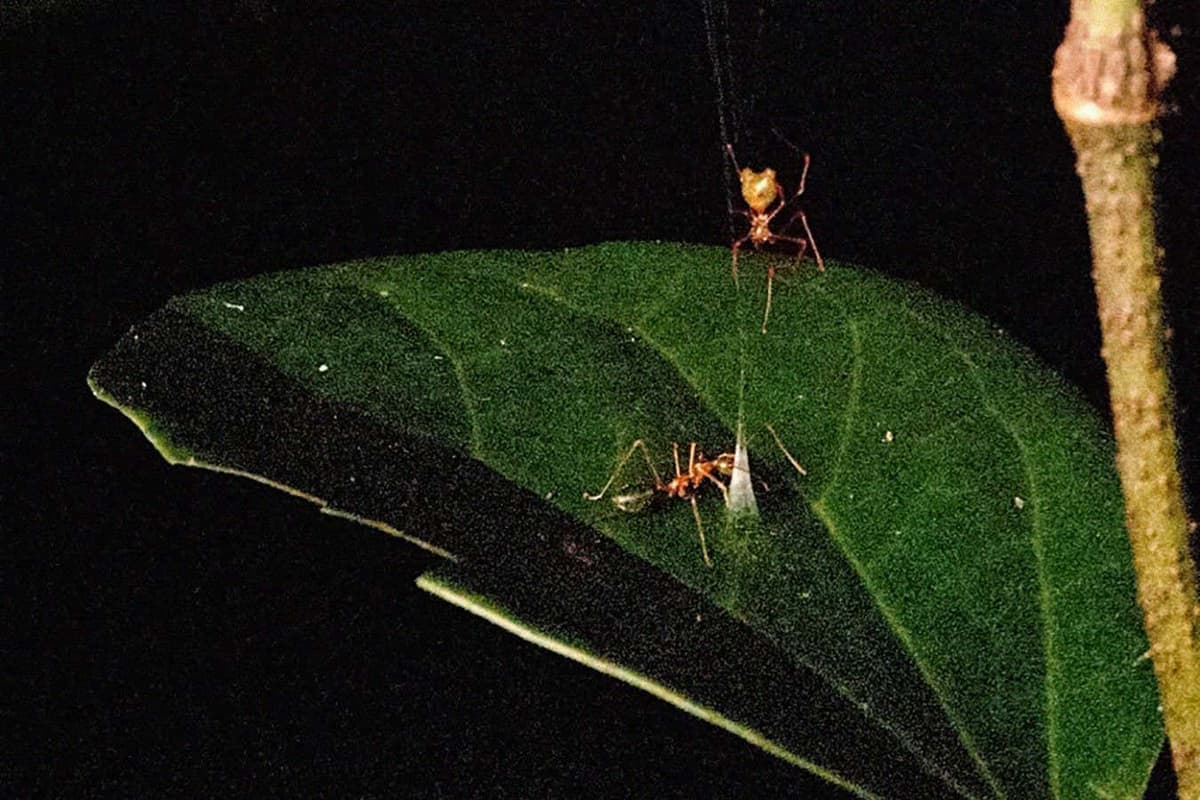
New-to-Science Spider Builds Trap that Flings Ants Into the Air
Why It Matters
The find reveals a unique predatory mechanism that combines biomechanics and chemical luring, offering fresh insights for evolutionary biology and potential inspiration for micro‑robotic capture systems.
Key Takeaways
- •Ballista spider builds 15–60 tension lines forming a conical snare
- •Trap launches green tree ants 30 cm upward at 130 g acceleration
- •Chemical lure attracts only Oecophylla smaragdina, avoiding other insects
- •Construction takes up to four hours, performed nightly after dusk
- •Strategy lifts prey away from ant colony, reducing retaliation risk
Pulse Analysis
The ballista spider, an as‑yet‑unnamed member of the genus Propostira, was first observed when a researcher captured a blur of an ant being flung from a leaf. High‑speed cameras revealed a meticulously engineered snare: a cone of silk tension lines that store elastic energy until a single ant’s mandibles trigger release. This discovery adds a new chapter to arachnid hunting strategies, which traditionally rely on passive webs or active ambush, and underscores the value of field‑based high‑resolution videography in uncovering hidden natural phenomena.
From a biomechanics perspective, the spider’s trap generates forces comparable to those experienced by fighter pilots during extreme maneuvers. An acceleration of 1,367 m s⁻² translates to roughly 130 times Earth’s gravity, enough to kill a human under sustained load. The spider achieves this by pre‑loading silk fibers to a precise tension, then converting that stored energy into kinetic motion in a fraction of a second. Such a natural high‑speed launcher could inspire engineers designing micro‑scale delivery devices, where rapid, controlled release of payloads is essential for medical or environmental applications.
Ecologically, the spider’s specialization on green tree ants—an aggressive, colony‑defending species—highlights an evolutionary arms race. By flinging prey away from the ant trail, the spider minimizes the risk of collective retaliation, turning a dangerous food source into a reliable one. This behavior may influence ant foraging patterns and could prompt further studies on how solitary predators adapt to social insect defenses. Future research will likely explore the chemical cues involved, the silk’s material properties, and the potential existence of similar mechanisms in other understudied rainforest arthropods.
New-to-science spider builds trap that flings ants into the air
Comments
Want to join the conversation?
Loading comments...