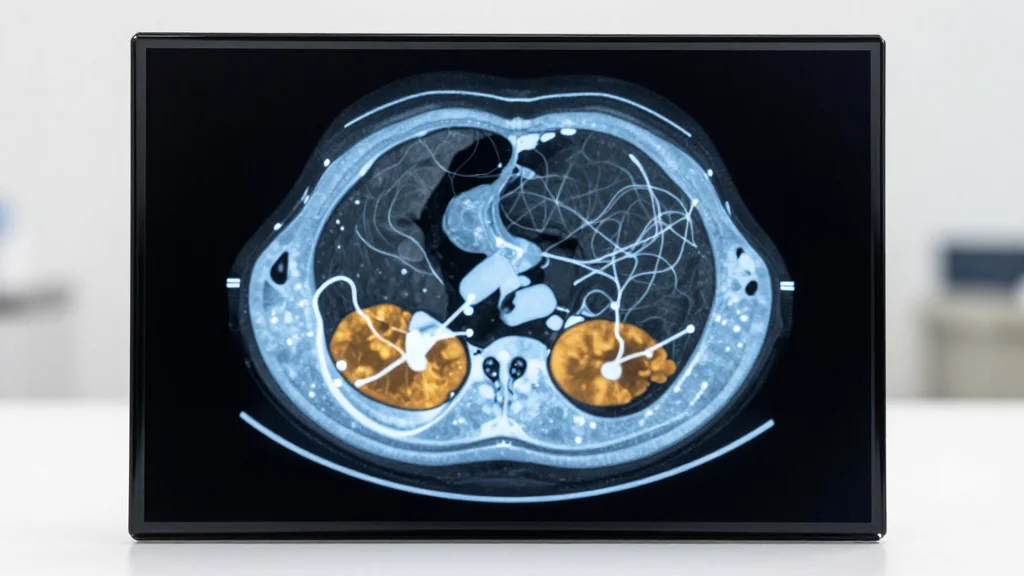
New Tomography-Based Marker Advances Accuracy of Gastric Cancer Prognosis
Why It Matters
The VMD marker gives oncologists a powerful, low‑cost tool to identify high‑risk gastric‑cancer patients, enabling more personalized treatment decisions. Its ability to capture systemic health alongside tumor characteristics could improve survival and reduce unnecessary therapy.
Key Takeaways
- •VMD marker uses CT radiodensity difference between visceral fat and muscle.
- •Elevated VMD predicts median survival of 13.8 months vs 58.5 months.
- •Machine‑learning refined VMD, reducing scanner‑specific variability.
- •VMD could guide personalized chemotherapy intensity for gastric cancer patients.
Pulse Analysis
The integration of quantitative imaging into oncology has moved beyond tumor size to capture the host’s metabolic and inflammatory status. Recent advances show that visceral fat and skeletal muscle radiodensity, readily extracted from routine CT scans, correlate with outcomes across multiple malignancies. By treating these radiodensity metrics as biomarkers, clinicians can assess a patient’s physiological reserve without additional procedures or cost. This shift reflects a broader precision‑medicine trend where the tumor microenvironment and systemic health are evaluated together to refine risk stratification.
The Visceral Muscle Difference (VMD) marker, developed by a UNICAMP team, quantifies the gap between visceral adipose and muscle radiodensity, turning raw imaging data into a single prognostic score. Machine‑learning pipelines screened thousands of radiodensity combinations, selecting the differential metric that maximized survival discrimination while neutralizing scanner‑specific calibration differences. In a cohort of 461 gastric‑cancer patients, a high VMD score corresponded to a median overall survival of just 13.8 months, compared with 58.5 months for low‑risk profiles—a prognostic gap that outperforms conventional staging alone.
Clinicians can leverage VMD to triage patients toward intensified chemotherapy, targeted nutrition, or early palliative care, aligning treatment intensity with physiological vulnerability. Because the metric derives from standard CT scans, implementation incurs minimal extra cost and can be retrofitted into existing radiology workflows. Ongoing prospective trials will test VMD’s reproducibility across diverse populations and explore whether interventions that improve muscle quality or reduce visceral inflammation can shift scores and extend survival. If validated, the VMD framework may become a universal frailty index, extending its utility beyond gastric cancer to other solid tumors.
New Tomography-Based Marker Advances Accuracy of Gastric Cancer Prognosis
Comments
Want to join the conversation?
Loading comments...