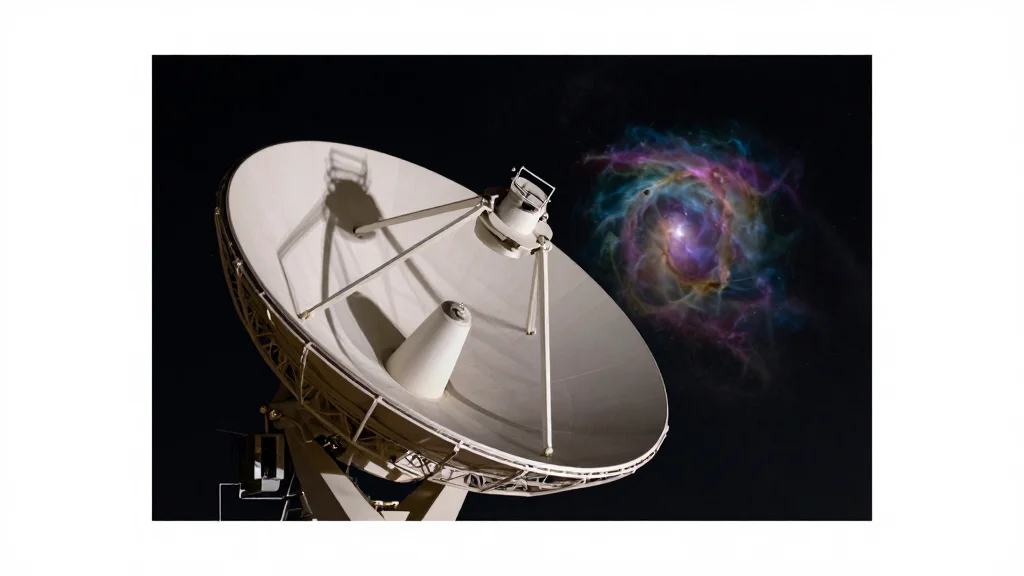
Newly Confirmed Supernova Remnant Is One of the Faintest Ever Detected
Why It Matters
Faint, high‑latitude supernova remnants like Abeona are rare, offering unique insight into Type Ia explosion physics and cosmic‑ray acceleration in low‑density environments, which refines Galactic high‑energy models.
Key Takeaways
- •Abeona's radio flux density measured at 1.5 Jy, unusually low.
- •Surface brightness 24 000 Jy sr⁻¹ ranks among faintest SNRs.
- •Located 16 000 ly away, 1 500 ly below Galactic plane.
- •Overlaps gamma‑ray source 4FGL J1413.9–6705, hinting at particle acceleration.
Pulse Analysis
The discovery of Abeona showcases ASKAP’s ability to detect extremely low‑surface‑brightness radio structures that elude traditional surveys. By imaging a 30‑arcminute bilateral shell with a mere 1.5 Jy flux, astronomers have pushed the sensitivity frontier, adding a new member to the short list of faint supernova remnants. This achievement underscores the value of wide‑field, high‑resolution interferometers for mapping the diffuse radio sky and filling gaps in the Galactic SNR census.
Beyond its modest brightness, Abeona’s location—roughly 1 500 light‑years beneath the Galactic plane—places it in a rare high‑latitude environment where interstellar densities are low. The lack of an infrared counterpart and the presence of linearly polarized synchrotron emission point to a non‑thermal origin, while the overlapping gamma‑ray source 4FGL J1413.9–6705 suggests active particle acceleration. The authors infer a Type Ia progenitor, adding to the growing subset of off‑plane SNRs that serve as natural laboratories for studying cosmic‑ray diffusion and shock physics under conditions distinct from the crowded Galactic disk.
Looking ahead, Abeona will be a prime target for next‑generation facilities such as the Square Kilometre Array and the Cherenkov Telescope Array, which can probe its high‑energy emission with unprecedented precision. Multi‑wavelength campaigns—including X‑ray, optical, and TeV observations—could reveal any hidden compact object and refine distance estimates. As more faint, halo‑bound remnants are cataloged, models of Galactic supernova rates, chemical enrichment, and cosmic‑ray propagation will become increasingly robust, reinforcing the strategic importance of deep radio surveys in astrophysics.
Newly confirmed supernova remnant is one of the faintest ever detected
Comments
Want to join the conversation?
Loading comments...