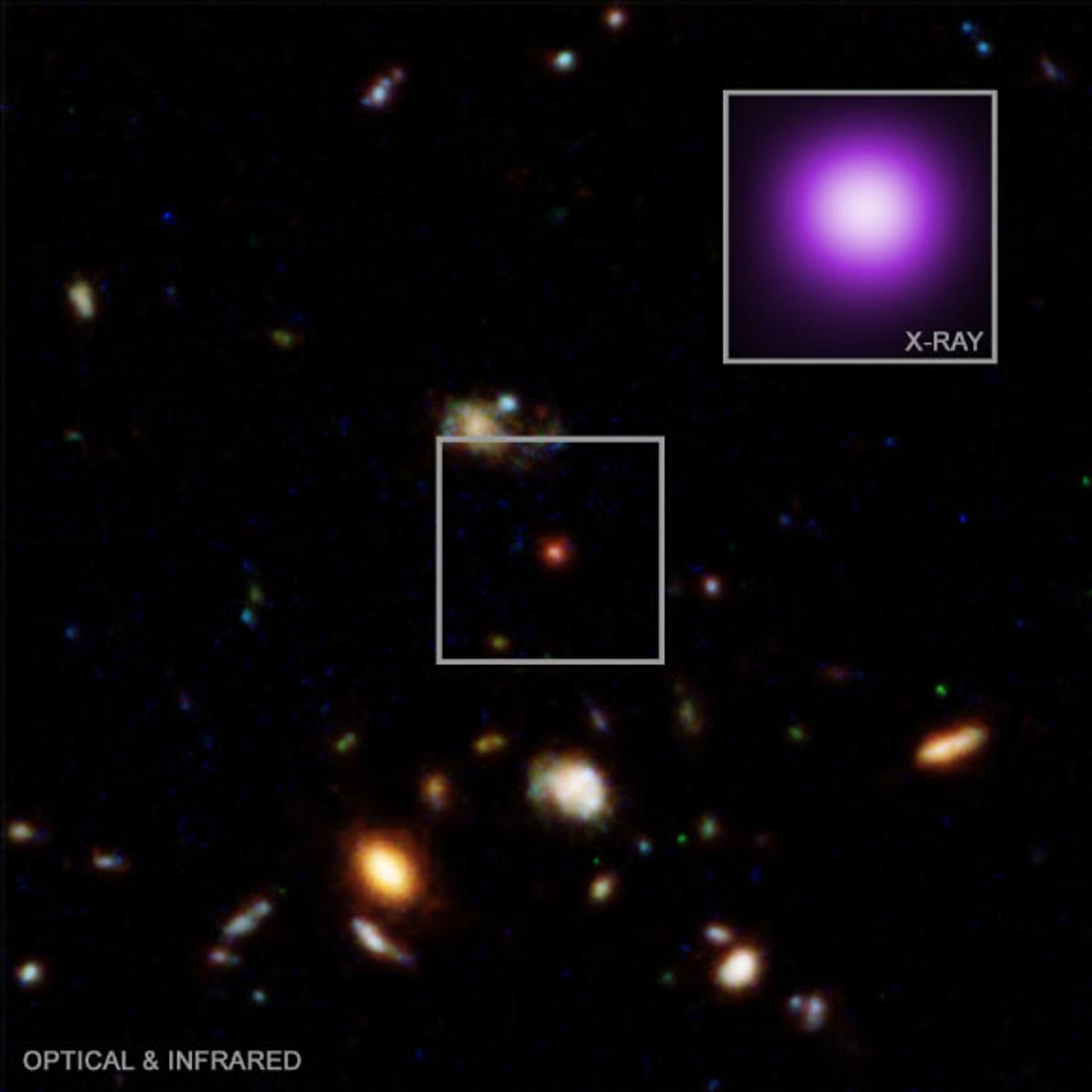
Newly-Discovered ‘X-Ray Dot’ Object May Reveal What Mysterious ‘Little Red Dots’ Really Are
Why It Matters
The X‑ray dot provides the first direct evidence that some LRDs are evolving into unobscured supermassive black holes, reshaping theories of early black‑hole growth and galaxy evolution.
Key Takeaways
- •X‑ray dot 3DHST‑AEGIS‑12014 emits X‑rays unlike typical LRDs
- •Located ~11.8 billion light‑years away, bridging LRDs and SMBHs
- •Suggests transition phase where gas clouds thin, revealing X‑ray emission
- •Variable X‑ray brightness indicates partially obscured black hole
- •JWST and Chandra collaboration uncovered object hidden in decade‑old data
Pulse Analysis
The astronomical community has been grappling with the nature of the so‑called “little red dots” (LRDs) ever since the James Webb Space Telescope (JWST) first catalogued hundreds of faint, red sources at redshifts beyond 2, corresponding to more than 12 billion light‑years. These objects appear compact and heavily reddened, leading many researchers to suspect they are nascent supermassive black holes shrouded in dense gas and dust that suppress their ultraviolet and X‑ray signatures. The recent identification of an X‑ray‑bright counterpart, designated 3DHST‑AEGIS‑12014, offers the first direct glimpse of an LRD that breaks this pattern.
Located roughly 11.8 billion light‑years away, the X‑ray dot exhibits the same red optical colors as typical LRDs but shines brightly in the Chandra X‑ray band. Its intermittent X‑ray flux suggests a partially obscured accretion disk, consistent with a scenario in which the surrounding gas cloud is being eroded, creating “holes” that let high‑energy photons escape. This transitional state bridges the gap between the heavily veiled black‑hole‑star phase and the unobscured, rapidly growing supermassive black holes that dominate later cosmic epochs. An alternative hypothesis invokes an exotic dust composition that permits X‑ray leakage while still reddening the optical light.
Confirming the X‑ray dot’s role as a missing‑link object will sharpen models of black‑hole seed growth and the co‑evolution of galaxies in the early universe. Planned deep‑field observations with JWST’s NIRSpec and further time‑resolved monitoring by Chandra will test the variability pattern and probe the surrounding medium’s composition. The discovery also underscores the power of cross‑mission data mining: a decade‑old Chandra survey point became transformative only after JWST supplied the missing infrared context. As more hybrid detections emerge, astronomers expect a clearer census of the hidden black‑hole population.
Newly-Discovered ‘X-ray Dot’ Object May Reveal What Mysterious ‘Little Red Dots’ Really Are
Comments
Want to join the conversation?
Loading comments...