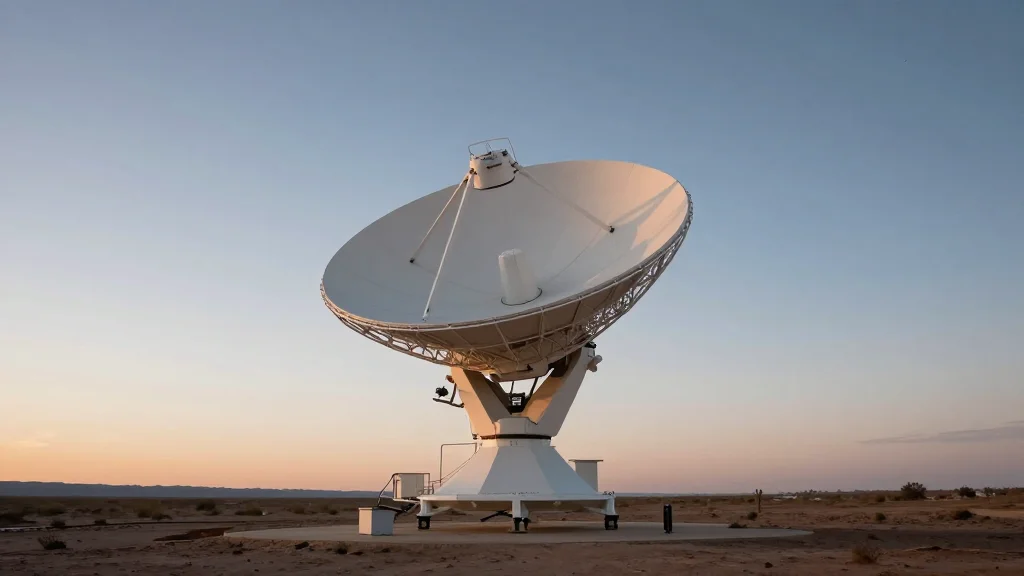
Next Generation Very Large Array Prototype Achieves First Light
Why It Matters
First light proves the NGVLA’s technology viability, positioning the United States to lead next‑generation radio astronomy and to capture deeper cosmic signals than ever before.
Key Takeaways
- •Prototype NGVLA dish captured first astronomical signal in March 2024.
- •Project funded by $30 million NSF grant and $10 million NRAO support.
- •Wideband receivers cover 1.2–116 GHz, enabling unprecedented sky surveys.
- •Design aims for 10‑fold sensitivity increase over current VLA.
- •First light validates engineering path for full NGVLA array slated for 2030s.
Pulse Analysis
The NGVLA prototype’s first light marks a watershed moment for U.S. radio astronomy, showcasing a new class of ultra‑wideband receivers that span from L‑band to millimeter wavelengths. By covering 1.2‑116 GHz, the system can simultaneously probe neutral hydrogen, molecular lines, and continuum emission, dramatically accelerating sky surveys and enabling discoveries from the epoch of reionization to nearby star‑forming regions. This capability far exceeds the frequency agility of the legacy VLA, promising richer datasets for both astrophysics and cosmology.
Beyond the technical triumph, the project’s $40 million investment—$30 million from the National Science Foundation and $10 million from the National Radio Astronomy Observatory—signals strong federal commitment to maintaining global leadership in radio facilities. The prototype’s success reduces risk for the full NGVLA, slated for deployment in the 2030s, by confirming that the modular dish design, cryogenic front‑ends, and data transport architecture meet performance targets. This risk mitigation is crucial for securing additional funding and for aligning international partners who are watching the U.S. roadmap closely.
Looking ahead, the NGVLA will complement other flagship observatories such as the James Webb Space Telescope and the upcoming Extremely Large Telescope, providing the radio counterpart to multi‑messenger astronomy. Its tenfold sensitivity boost will open new windows on faint, high‑redshift galaxies and enable precise mapping of magnetic fields across the cosmos. As the scientific community prepares for the era of massive data streams, the NGVLA’s advanced digital back‑end and real‑time processing pipelines will also drive innovations in high‑performance computing, benefitting sectors beyond astronomy.
Next Generation Very Large Array Prototype Achieves First Light
Comments
Want to join the conversation?
Loading comments...