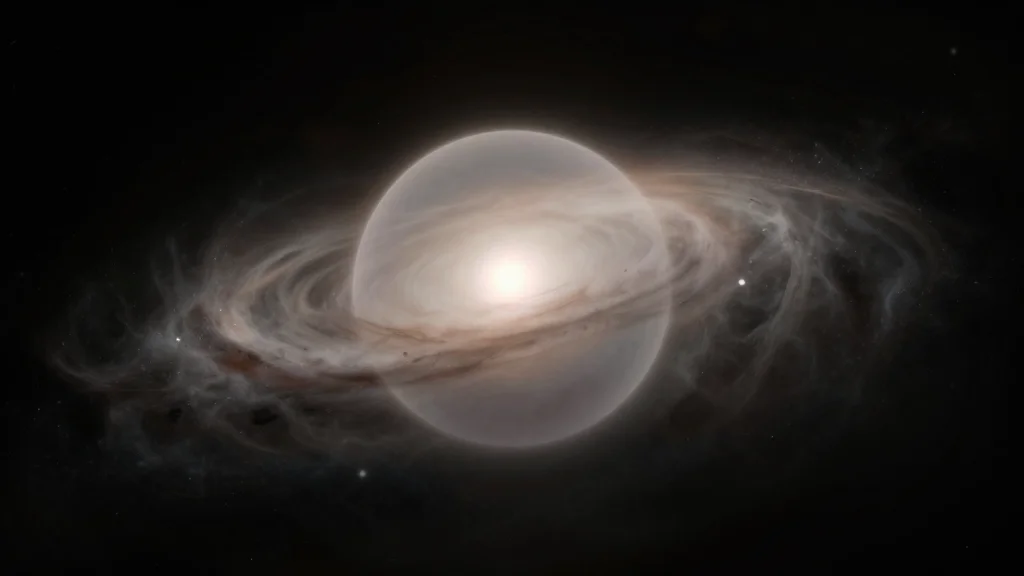
Non-Rotating Early Galaxy Is a Surprise to Astronomers
Why It Matters
The discovery forces a rethink of how quickly angular momentum builds in nascent galaxies, impacting theories of cosmic structure formation. It also highlights potential gaps in our understanding of dark‑matter halo behavior during the universe’s first billion years.
Key Takeaways
- •Galaxy observed at redshift 7, ~800 million years after Big Bang
- •No detectable rotation despite massive stellar disk
- •Findings challenge standard hierarchical galaxy formation models
- •Data gathered using JWST's NIRSpec instrument
- •Implications for dark matter halo dynamics in early universe
Pulse Analysis
The conventional picture of galaxy evolution holds that early systems rapidly acquire angular momentum, forming rotating disks that later evolve into spirals like the Milky Way. Simulations based on cold dark matter predict turbulent, yet orderly, spin-up as gas collapses within dark‑matter halos. However, the newly identified non‑rotating galaxy upends this narrative, suggesting that the mechanisms driving spin may be delayed or suppressed under certain conditions in the infant universe.
The breakthrough came from deep spectroscopic observations with JWST’s Near‑Infrared Spectrograph (NIRSpec), which captured emission lines across the galaxy’s extent. By mapping the Doppler shift of these lines, astronomers expected to see a gradient indicative of rotation. Instead, the velocity field remained flat, implying the stellar mass is supported by random motions rather than coherent spin. The galaxy’s stellar mass rivals that of present‑day dwarf galaxies, yet its kinematic signature is more akin to a pressure‑supported spheroid, a surprising hybrid for such an early epoch.
If early galaxies can exist without significant rotation, theoretical frameworks must accommodate alternative pathways for mass assembly, perhaps involving rapid mergers or intense feedback that stirs the gas. This finding also raises questions about the role of dark‑matter halos in shaping early dynamics, potentially pointing to variations in halo spin or density profiles. Future JWST surveys and complementary observations from ALMA will be crucial to determine whether this object is an outlier or part of a broader, previously hidden population, reshaping our view of cosmic dawn.
Non-Rotating Early Galaxy Is a Surprise to Astronomers
Comments
Want to join the conversation?
Loading comments...