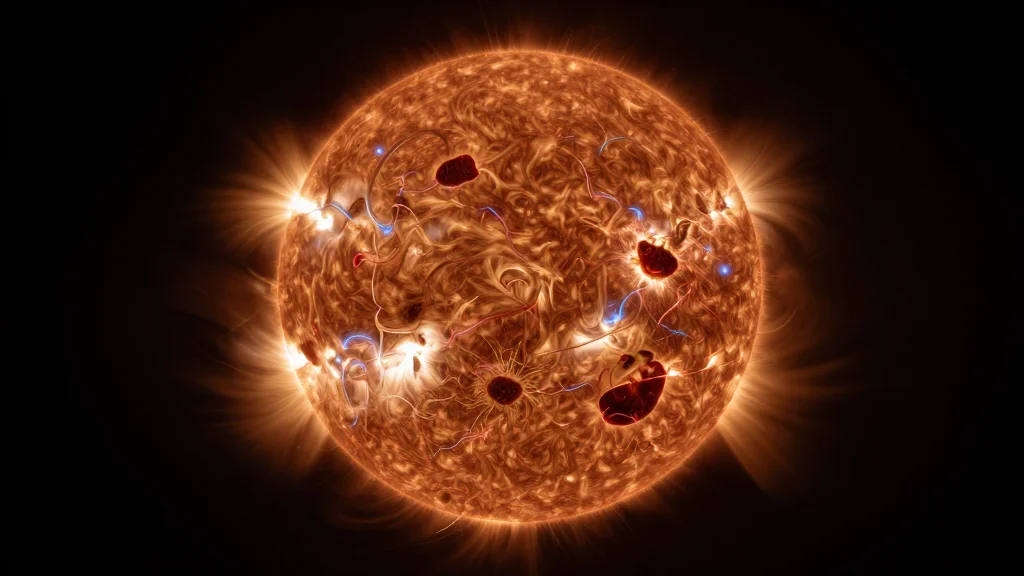
NSF‑NOAA GONG Maps Sun’s Far‑Side Magnetic Fields, Boosting Space‑Weather Forecasts

Why It Matters
Accurate space‑weather forecasts are essential for safeguarding modern technology, from GPS navigation to power‑grid stability. By revealing magnetic polarity on the Sun’s far side, the new GONG‑based maps give scientists a crucial early warning of potentially hazardous solar eruptions, extending the lead time for mitigation measures. This capability also enhances scientific understanding of solar magnetic dynamics, informing models of the solar cycle and improving long‑term climate predictions that factor in solar variability. Beyond operational benefits, the technique demonstrates the power of combining helioseismology with physics‑based inversion methods, a paradigm that could be applied to other stellar observations. As solar observation networks become more integrated globally, the ability to generate complete magnetic maps of the Sun in near real‑time may set a new standard for space‑weather readiness worldwide.
Key Takeaways
- •NSF NSO and NOAA used GONG helioseismic data to assign magnetic polarity to far‑side sunspots.
- •The physics‑driven algorithm converts phase‑shift amplitudes into signed magnetic‑field maps.
- •Validation against Solar Orbiter’s SO/PHI instrument showed strong agreement in polarity and strength.
- •Active regions 13663 and 13664, linked to May 2024 storms, were mapped with polarity and tilt angle for the first time.
- •Real‑time integration into NOAA’s SWPC is planned to improve early warning of geomagnetic storms.
Pulse Analysis
The NSF‑NOAA collaboration bridges a critical observational gap that has long limited space‑weather prediction. Historically, forecasters relied on helioseismic detections that only indicated the presence of far‑side active regions, leaving the magnetic configuration—a key driver of CME geoeffectiveness—unknown. By delivering polarity‑resolved magnetograms, the new method injects a missing variable into predictive models, potentially reducing false alarms and missed events.
From a market perspective, the advancement could stimulate demand for next‑generation solar monitoring hardware and software. Companies that provide space‑weather services, such as SpaceX’s satellite constellation operators and utilities with high‑voltage transmission lines, stand to benefit from more accurate forecasts. Moreover, the technique showcases the value of public‑sector research partnerships; the modest investment in GONG infrastructure yields outsized returns in risk mitigation for multi‑billion‑dollar industries.
Looking forward, the real test will be operational reliability. Integrating the far‑side polarity maps into NOAA’s forecasting workflow will require automated pipelines, robust error handling, and continuous validation against in‑situ measurements. If these hurdles are cleared, the approach could become a template for other stellar observatories seeking to infer magnetic properties from acoustic signatures, extending its impact beyond Earth’s immediate space‑weather concerns.
NSF‑NOAA GONG Maps Sun’s Far‑Side Magnetic Fields, Boosting Space‑Weather Forecasts
Comments
Want to join the conversation?
Loading comments...