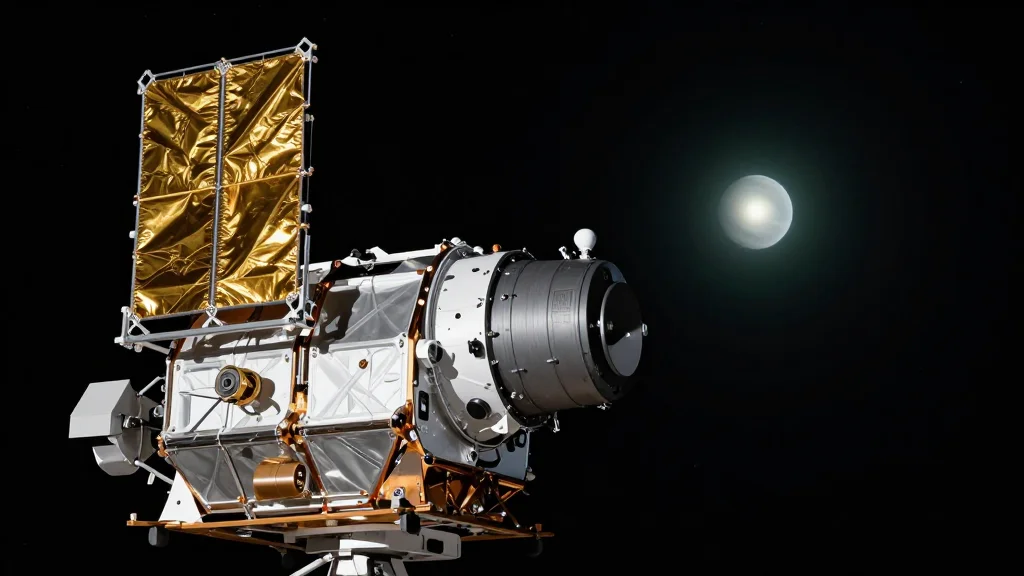
Observational Astronomer William Balmer Awarded 51 Pegasi B Fellowship
Why It Matters
The fellowship accelerates cutting‑edge exoplanet imaging, offering unprecedented insight into planet formation and atmospheric chemistry, while fostering a new generation of interdisciplinary astronomers.
Key Takeaways
- •Balmer receives $450K 51 Pegasi b Fellowship for three-year exoplanet imaging research
- •Direct imaging captured first exoplanet CO₂ signatures using JWST in 2025
- •Fellowship enables collaboration with Northwestern’s Jason Wang and continued JWST observations
- •Study targets a 5‑million‑year‑old giant planet to probe early atmospheric formation
- •Balmer’s interdisciplinary background blends arts and science, enhancing communication of findings
Pulse Analysis
The Heising‑Simons Foundation’s 51 Pegasi b Fellowship, worth up to $450,000 over three years, places William Balmer at the forefront of exoplanet direct‑imaging research. Unlike transit spectroscopy, direct imaging captures photons emitted or reflected by the planet itself, allowing astronomers to dissect atmospheric composition with unprecedented detail. By moving to Northwestern University under the mentorship of Assistant Professor Jason Wang, Balmer will leverage state‑of‑the‑art instrumentation and data‑processing pipelines to expand the modest pool of scientists capable of turning faint planetary glows into quantitative science. The summit fosters mentorship and data‑sharing among emerging planetary scientists.
Balmer’s 2025 breakthrough—directly imaging carbon‑dioxide in a distant giant planet with the James Webb Space Telescope—proved that JWST can move beyond indirect spectral inference to genuine chemical mapping. The detection confirmed that the system’s four giants assembled through core accretion, mirroring the formation pathways of Jupiter and Saturn. This empirical validation sharpens theoretical models of planet formation, especially the transition from solid cores to gas envelopes, and provides a template for future surveys targeting younger, lower‑mass worlds where atmospheric signatures are even fainter. Such data will refine models of atmospheric chemistry across diverse worlds.
The upcoming JWST campaign on a five‑million‑year‑old giant planet will let Balmer’s team monitor real‑time accretion and atmospheric evolution, delivering the first quantitative constraints on how nascent planets gather material. Coupled with Balmer’s background in literary arts, the project is poised to produce compelling narratives that bridge complex astrophysics and public outreach, a skill increasingly prized by funding agencies. As the exoplanet field matures, fellowships that blend technical expertise with communication talent are likely to shape the next generation of discovery‑driven astronomy. Findings will guide future coronagraph designs for even fainter targets.
Observational astronomer William Balmer awarded 51 Pegasi b Fellowship
Comments
Want to join the conversation?
Loading comments...