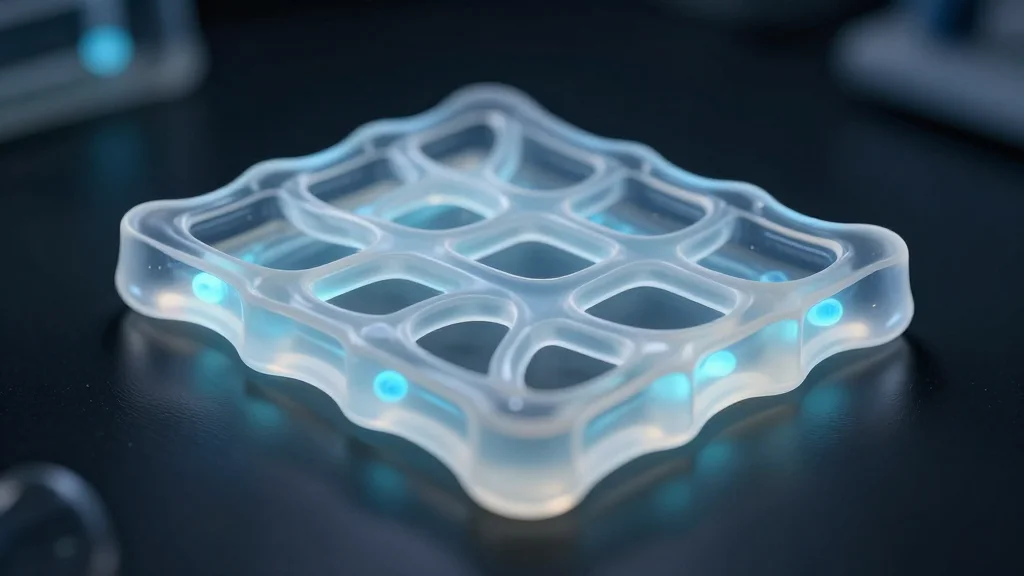
Ocean Glow Meets 3D Printing with Living Gels that Sense Mechanical Force
Why It Matters
The technology merges additive manufacturing with living cells to produce self‑sustaining sensors, opening pathways for lightweight, energy‑independent soft robotics and distributed environmental monitoring.
Key Takeaways
- •DLP printing embeds Pyrocystis lunula in hydrogel matrices
- •Printed gels emit blue light when mechanically stressed
- •Materials act as autonomous sensors without batteries or processors
- •Complex gyroid structures enable soft robotic components
- •Light-based communication offers rapid, wiring‑free data transfer
Pulse Analysis
The convergence of biology and additive manufacturing is reshaping material science, and the recent Empa breakthrough exemplifies this shift. By leveraging digital light processing, researchers can suspend living dinoflagellates within a photocurable resin, solidifying complex three‑dimensional forms in a single step. This approach sidesteps the multi‑material assembly challenges that have long limited bio‑integrated devices, delivering precise spatial control over cell placement while preserving cellular viability.
Mechanoluminescence—light emission triggered by mechanical deformation—lies at the heart of the new gels. Pyrocystis lunula naturally converts kinetic energy into a vivid blue flash, a response that the printed matrix amplifies and directs. The resulting material acts as a distributed sensor network, where each micro‑cell functions as a band‑pass filter, activating only when stress exceeds a predefined threshold. Because the signal is optical, data transmission occurs at the speed of light without the need for conductive wiring, batteries, or external processors, dramatically reducing system weight and power consumption.
The implications for soft robotics and environmental monitoring are profound. Engineers can now fabricate robotic skins, grippers, or underwater probes that self‑report strain, pressure, or flow conditions through simple visual cues. Industries ranging from marine exploration to wearable technology stand to benefit from components that are both structurally intricate and biologically active. As research progresses toward scaling production and integrating additional cellular functionalities, living 3D‑printed gels could become foundational building blocks for the next generation of autonomous, energy‑independent devices.
Ocean glow meets 3D printing with living gels that sense mechanical force
Comments
Want to join the conversation?
Loading comments...