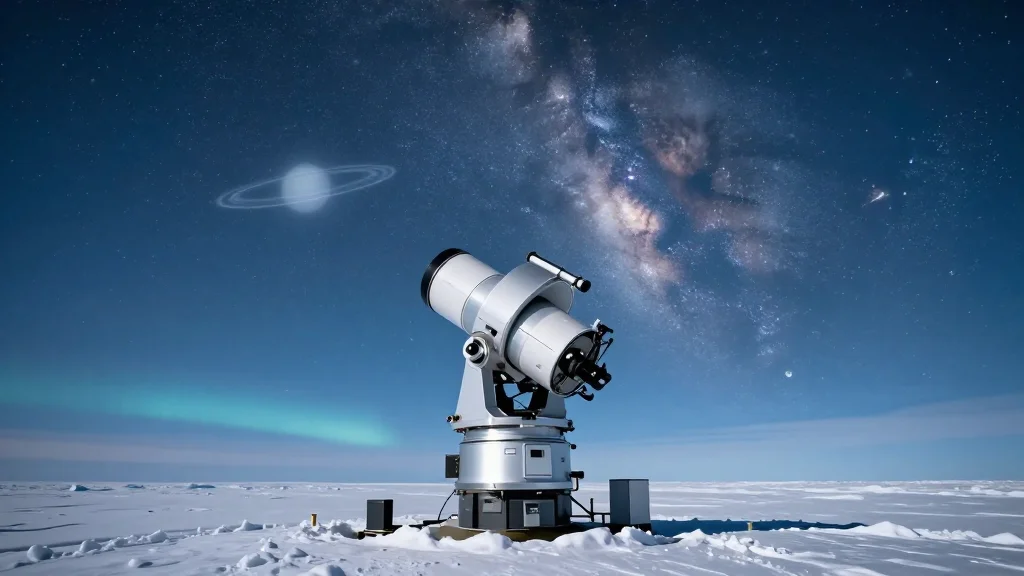
Oddball Exoplanet System Discovered with Help of Antarctic Telescope
Why It Matters
The find challenges standard models of planetary migration and highlights Antarctica’s emerging role as a premier site for high‑precision exoplanet observations, potentially accelerating future discoveries.
Key Takeaways
- •Three‑planet system includes a 0.92 eccentricity world
- •One planet orbits retrograde, defying formation expectations
- •AST3’s 0.5‑arcsecond seeing rivals space‑based telescopes
- •Discovery expands known diversity of planetary architectures
- •Antarctic site offers uninterrupted winter observing windows
Pulse Analysis
The oddball exoplanet system was uncovered by the Antarctic Survey Telescope (AST3), a 0.5‑meter instrument stationed at Dome A, the highest and coldest point on the continent. The extreme cold and stable atmosphere produce exceptionally low scintillation, allowing astronomers to detect minute brightness dips that would be lost at temperate sites. By combining continuous winter night observations with advanced detrending algorithms, the team recorded a series of transit events that revealed three planets with surprising orbital dynamics.
One of the planets, designated AS‑2026b, follows an elongated orbit that brings it within 0.05 AU of its star at periastron before swinging out to 1.2 AU, creating temperature swings far beyond those seen in our solar system. A second planet, AS‑2026c, moves in a retrograde direction, suggesting a violent past—perhaps a close‑in stellar encounter or planet‑planet scattering that flipped its orbital plane. These characteristics strain conventional migration theories, which typically predict more orderly, coplanar systems, and they provide a natural laboratory for testing models of dynamical instability.
Beyond the scientific intrigue, the discovery underscores Antarctica’s growing strategic importance for astronomy. The continent’s polar night offers uninterrupted monitoring for weeks, while the thin, dry air minimizes infrared absorption, rivaling space‑based platforms at a fraction of the cost. As global observatories look to diversify sites, the success of AST3 may spur investment in larger Antarctic telescopes, accelerating the hunt for Earth‑like worlds and refining our understanding of planetary system evolution.
Oddball Exoplanet System Discovered with Help of Antarctic Telescope
Comments
Want to join the conversation?
Loading comments...