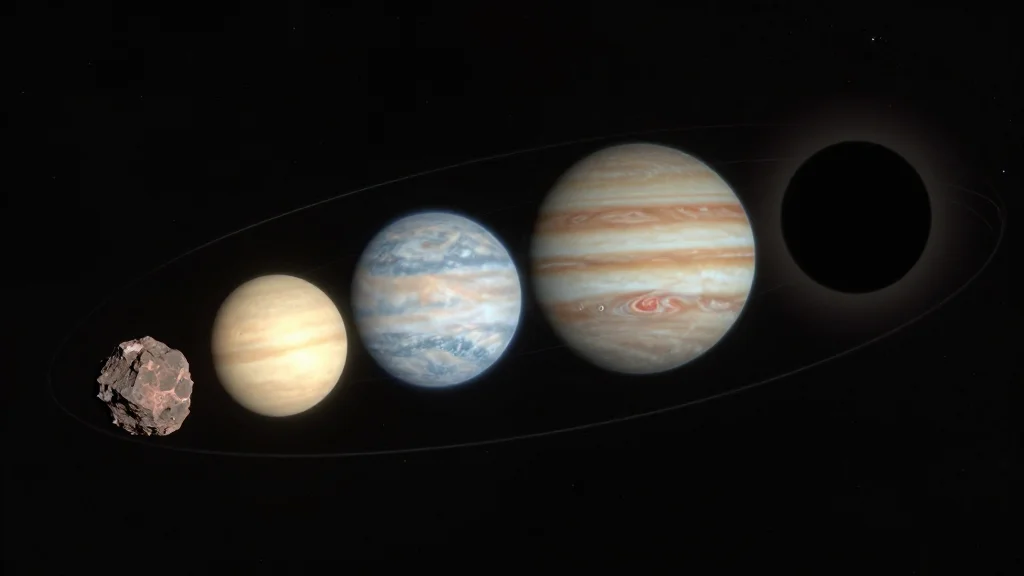
One Graph Attempts to Connect Every Object in the Universe
Why It Matters
The unified diagram bridges disparate subfields of astronomy, offering a single visual framework that clarifies how mass and density govern object classification and evolution. It equips researchers and educators with a powerful tool for comparing bodies that were previously studied in isolation.
Key Takeaways
- •2,157 objects plotted, covering 12 orders of magnitude in mass
- •Transition from irregular to spherical occurs between Vesta and Mimas
- •Ice giants show density drop, gas giants resume increase
- •Brown dwarfs overlap massive gas giants on density‑mass diagram
- •White dwarfs, neutron stars, black holes appear as extreme outliers
Pulse Analysis
The Cohesive Object Sequence builds on the legacy of the Hertzsprung‑Russell diagram, extending its unifying power beyond stars to every "cohesive" object in the cosmos. By plotting density against mass for over two thousand bodies, the researchers provide a single visual language that captures the physics of gravitational compression, material composition, and internal structure. This approach not only highlights familiar trends—such as the linear rise of density with mass for rocky worlds—but also uncovers subtle inflection points that were previously hidden in fragmented data sets.
One of the most striking insights is the clear demarcation between irregular and spherical bodies, pinpointed between the asteroid Vesta and Saturn’s moon Mimas. The diagram also delineates three planetary regimes: terrestrial planets with a steady density increase, ice giants where added mass lowers density, and gas giants that revert to a positive correlation beyond roughly 100 Earth masses. Perhaps more provocative is the overlap of brown dwarfs with the heaviest gas giants, suggesting that the traditional categorical line between sub‑stellar and stellar objects may be more observational than physical. Outliers such as white dwarfs, neutron stars, and black holes stand apart, reinforcing the extreme physics governing compact remnants.
Beyond its scientific revelations, the graph serves as a pedagogical bridge, allowing educators to illustrate the continuum from small Solar System rocks to the most massive compact objects in a single frame. While the low‑mass data rely heavily on Solar System measurements, the framework invites future exoplanet discoveries to test its universality. As astronomers gather more precise mass and radius data from missions like TESS and JWST, the Cohesive Object Sequence could evolve into a standard reference, fostering cross‑disciplinary dialogue and sharpening our understanding of how matter organizes itself across the universe.
One graph attempts to connect every object in the universe
Comments
Want to join the conversation?
Loading comments...