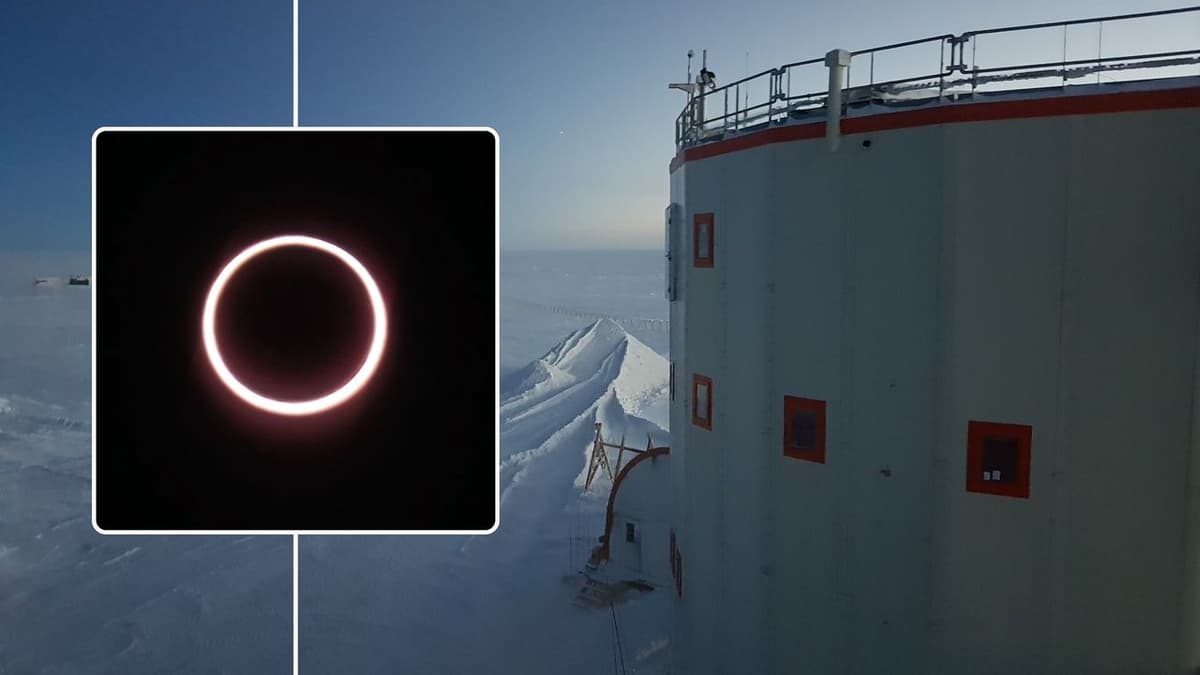
Only 12 People on Earth Saw This 'Ring-of-Fire' Eclipse. Here's How One Improvised to Capture a Once-in-a-Lifetime Photo From Antarctica
Why It Matters
The eclipse provided a rare scientific observation opportunity that only a handful of people could experience, highlighting Antarctica’s unique value for astronomy and space‑weather research while showcasing the ingenuity required in extreme environments.
Key Takeaways
- •Only 12 people on Earth saw the Feb 17, 2026 annular eclipse.
- •Concordia base in Antarctica was the sole clear-view location.
- •Photographer built a makeshift Mylar filter for safe solar imaging.
- •Image became ESA’s only Earth‑based photo of that eclipse.
- •Event underscores Antarctica’s role in astronomy and space‑weather research.
Pulse Analysis
Annular eclipses occur when the Moon’s apparent diameter is smaller than the Sun’s, leaving a bright ring around the dark disc. The February 2026 event’s path of annularity crossed the polar desert of Antarctica, a region that rarely hosts human observers. Only two research outposts lay within the narrow track, and while Mirny Station was cloud‑covered, Concordia’s clear skies offered an unobstructed view. This geographic coincidence turned an otherwise ordinary celestial event into a once‑in‑a‑lifetime spectacle for the 12 personnel stationed there.
Concordia Station, perched 10,600 ft above sea level and isolated 750 miles inland, supports multidisciplinary science ranging from glaciology to space medicine. When the eclipse arrived, the crew had no dedicated solar filters on hand. Leveraging leftover Mylar film—originally used for solar observations—Andrea Traverso fashioned a cardboard‑based filter, allowing his camera to capture the fleeting ring without damaging the sensor or his eyes. The improvisation underscores the resourcefulness required in remote outposts, where standard equipment may be unavailable and every observation must be engineered on the spot.
The resulting photograph, now the sole Earth‑based visual record of the February annular eclipse, was disseminated by the European Space Agency, amplifying public interest in both solar phenomena and polar research. It illustrates how isolated stations can contribute uniquely to space science, offering perspectives unavailable from ground‑based observatories at lower latitudes. As climate change reshapes polar conditions and satellite missions expand, such ground‑truth observations will become increasingly valuable for calibrating models of solar‑wind interactions and atmospheric dynamics.
Only 12 people on Earth saw this 'ring-of-fire' eclipse. Here's how one improvised to capture a once-in-a-lifetime photo from Antarctica
Comments
Want to join the conversation?
Loading comments...