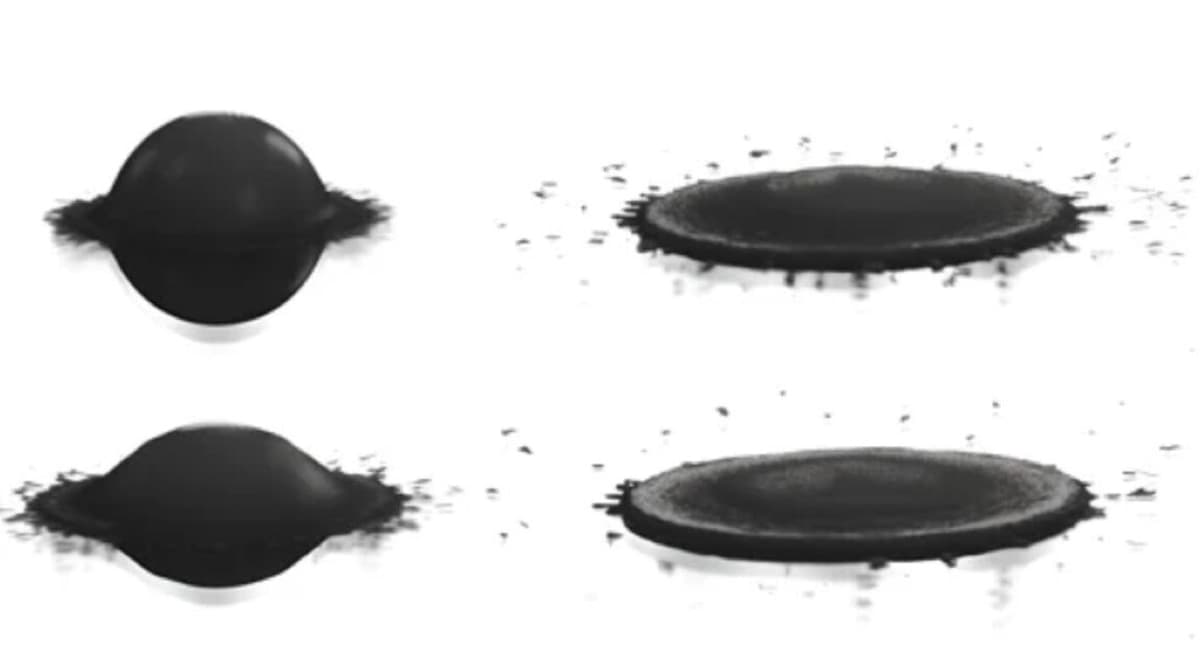
"Oobleck" Still Holds some Surprises
Why It Matters
The insight enables engineers to predict and control impact behavior of non‑Newtonian inks, improving precision in additive manufacturing and flexible electronics.
Key Takeaways
- •Dense oobleck drops spread briefly before solidifying.
- •High‑speed imaging captured ultrafast shear‑thickening transition.
- •Findings aid 3D printing of shear‑thickening inks.
- •Impacts design of soft‑robotic actuators and coatings.
- •Prior work links nanoparticle suspensions to similar behavior.
Pulse Analysis
The kitchen‑table mixture of cornstarch and water, popularly known as oobleck, has long served as a vivid illustration of non‑Newtonian fluid dynamics. Unlike Newtonian liquids such as water, whose viscosity remains constant, shear‑thickening fluids increase resistance when subjected to rapid deformation. This counter‑intuitive behavior underpins a range of everyday phenomena—from the stubborn flow of ketchup to the protective response of certain impact‑absorbing materials. Researchers have leveraged oobleck’s simplicity to probe the microscopic mechanisms that cause a liquid to behave like a solid in milliseconds.
In a recent Physical Review Letters paper, physicist Anahita Mobaseri and colleagues at the University of Minnesota captured the fleeting moment when a dense oobleck droplet strikes a flat surface. By varying corn‑starch concentrations and employing high‑speed cameras alongside force transducers, the team observed that highly concentrated drops first spread as if they were Newtonian, then instantaneously stiffen under ultrafast shear. This dual‑phase response had not been documented before and provides quantitative benchmarks for shear‑thickening models that must account for both fluid‑like spreading and rapid solidification.
The practical payoff of this insight reaches into additive manufacturing, soft‑robotics, and industrial coating technologies where precise control of fluid impact is critical. Shear‑thickening inks can now be engineered to spread uniformly before locking into shape, improving resolution in 3D‑printed components and reducing defects in spray‑on protective layers. Moreover, the study dovetails with earlier work on piezoelectric nanoparticle suspensions and conductive polymer films that mimic oobleck’s protective hardening, hinting at next‑generation wearable sensors that self‑reinforce on impact. Continued exploration of ultrafast rheology promises smarter materials across the supply chain.
"Oobleck" still holds some surprises
Comments
Want to join the conversation?
Loading comments...