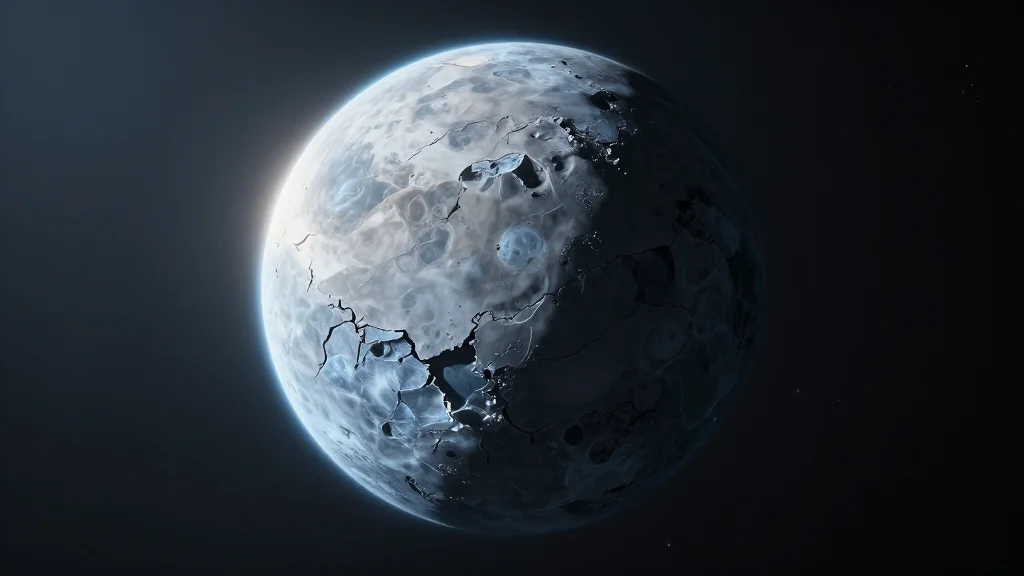
Outer Solar System Object Has an Atmosphere But Shouldn’t
Why It Matters
The finding proves that even the coldest Kuiper Belt bodies can retain or generate atmospheres, reshaping theories of outer‑solar‑system evolution and planetary geology.
Key Takeaways
- •Stellar occultation revealed a thin nitrogen atmosphere around TNO 2007 OR10.
- •Atmospheric pressure estimated at ~0.1 Pa, far lower than Earth's.
- •Object lies ~86 AU from Sun, temperature ~35 K, too cold to retain gases.
- •Detection suggests recent resurfacing or cryovolcanic activity on the dwarf planet.
- •Findings force revision of volatile‑loss models for distant solar system bodies.
Pulse Analysis
The discovery of an atmosphere on 2007 OR10 marks a watershed moment for planetary science. While most trans‑Neptunian objects are presumed inert and airless, the Subaru Telescope’s high‑precision occultation measurements captured a subtle bending of starlight, a hallmark of a gaseous envelope. This faint nitrogen layer, with pressure measured in fractions of a pascal, indicates that volatile compounds can persist or be regenerated far beyond the traditional frost line, prompting scientists to revisit thermal‑evolution calculations for Kuiper Belt objects.
Understanding how 2007 OR10 maintains an atmosphere at roughly 35 kelvin requires examining internal heat sources and surface processes. Cryovolcanism—where subsurface liquids erupt as volatile‑rich gases—offers a plausible mechanism, especially if radioactive decay or tidal interactions generate enough energy to melt ices. Such activity could periodically outgas nitrogen and methane, creating a transient, thin atmosphere that quickly escapes to space. This dynamic scenario aligns with recent observations of surface heterogeneity on other distant bodies, suggesting that the outer solar system may be more geologically active than previously thought.
The broader implications extend to models of solar‑system formation and the habitability potential of icy worlds. If dwarf planets can sporadically host atmospheres, they might also sustain temporary liquid layers beneath their surfaces, raising questions about prebiotic chemistry in these remote environments. Moreover, the detection underscores the value of coordinated occultation campaigns and next‑generation telescopes for probing the faintest signatures of planetary physics. As more distant objects are monitored, researchers anticipate a cascade of surprising findings that could rewrite the textbook narrative of a static, frozen Kuiper Belt.
Outer Solar System Object Has an Atmosphere But Shouldn’t
Comments
Want to join the conversation?
Loading comments...