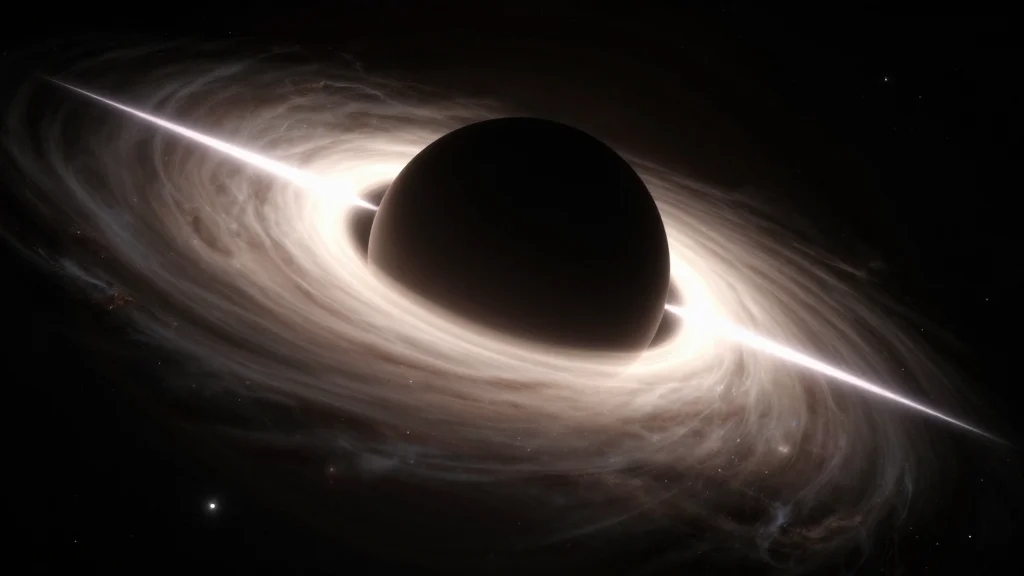
Oxford Team Confirms Black Hole Jets Carry 10% of Infall Energy, Matching Power of 10,000 Suns

Why It Matters
Directly measuring the fraction of accretion energy that powers jets resolves a long‑standing gap between theory and observation, allowing astrophysicists to calibrate models of black‑hole feedback with real data. This feedback mechanism is a cornerstone of galaxy‑formation theory, influencing star‑formation rates, gas heating, and the distribution of matter on cosmic scales. By establishing a reliable energy benchmark in a nearby stellar‑mass system, researchers can extrapolate to the vastly more energetic jets of supermassive black holes, improving predictions of how galaxies evolve over billions of years. The result also strengthens the scientific case for the Square Kilometre Array Observatory, demonstrating its capacity to deliver transformative measurements of high‑energy astrophysical phenomena. As SKAO comes online, its unprecedented sensitivity will enable systematic surveys of jet activity across the universe, potentially uncovering new classes of transient events and refining the role of black‑hole jets in the cosmic energy budget.
Key Takeaways
- •Oxford-led team measures Cyg X‑1 jets at half the speed of light (≈336 million mph).
- •Jets release energy equal to the combined output of 10,000 suns.
- •Study confirms ~10% of infalling matter’s energy powers black‑hole jets.
- •Findings published in Nature Astronomy provide a universal benchmark for jet energetics.
- •SKAO data underpin the measurement, highlighting the array’s future scientific impact.
Pulse Analysis
The confirmation that roughly one‑tenth of accretion energy fuels relativistic jets marks a pivotal calibration point for astrophysical simulations. For decades, cosmologists have injected a 10% efficiency parameter into large‑scale models to approximate black‑hole feedback, but the lack of observational grounding introduced systematic uncertainties that could cascade into predictions of galaxy clustering, star‑formation histories, and the thermal state of the intergalactic medium. By anchoring this parameter in a concrete, nearby system, the Oxford team reduces a major source of model variance, enabling tighter constraints on the role of active galactic nuclei in quenching star formation.
Historically, jet power estimates have relied on indirect proxies such as radio luminosity or X‑ray cavity measurements, each with its own set of assumptions. The Cyg X‑1 observation sidesteps many of these ambiguities by directly measuring jet speed and kinetic energy through SKAO’s high‑resolution radio imaging. This methodological leap not only validates the 10% rule for a stellar‑mass black hole but also suggests a scale‑invariant mechanism governing jet formation, likely tied to magnetic field configurations near the event horizon. If future SKAO surveys confirm similar efficiencies in supermassive systems, it would imply that magnetic flux threading the black‑hole horizon—rather than mass alone—sets the jet power, reinforcing magnetohydrodynamic models such as the Blandford‑Znajek process.
Looking ahead, the result will ripple through several research fronts. First, it will sharpen the input physics for next‑generation cosmological simulations like IllustrisTNG and EAGLE, which can now adopt an empirically vetted jet efficiency. Second, it will guide the design of observational campaigns targeting transient jet events, such as tidal‑disruption flares, where rapid energy release can be directly compared against the Cyg X‑1 benchmark. Finally, the study underscores the strategic importance of SKAO as a discovery engine; its ability to resolve jet dynamics in real time opens a new window on relativistic astrophysics, promising insights into black‑hole spin, accretion geometry, and the interplay between jets and their galactic environments.
Oxford Team Confirms Black Hole Jets Carry 10% of Infall Energy, Matching Power of 10,000 Suns
Comments
Want to join the conversation?
Loading comments...