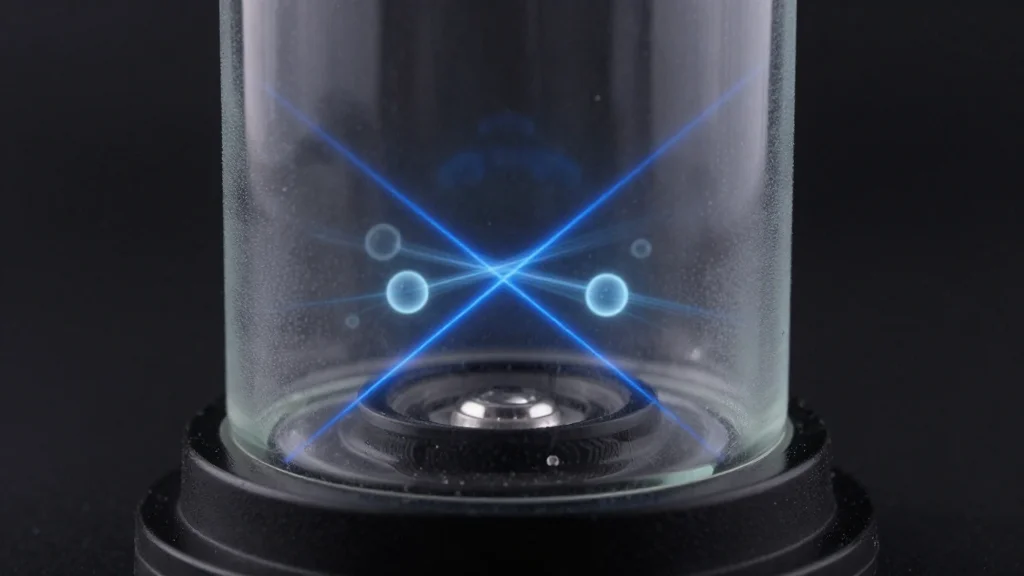
Pairs of Atoms Observed Existing in Two Places at Once for the First Time
Why It Matters
Demonstrating superposition with massive atoms bridges a critical gap between quantum theory and gravitational physics, paving the way for new quantum‑gravity experiments and advanced atom‑based technologies.
Key Takeaways
- •First observation of momentum‑entangled helium atom pairs.
- •Demonstrates superposition in massive particles, not just photons.
- •Opens experimental pathway to quantum‑gravity interface studies.
- •Validates century‑old predictions of matter existing in two locations.
- •May accelerate development of atom‑based quantum technologies.
Pulse Analysis
The landmark experiment conducted by researchers at the Australian National University marks the first time that pairs of helium atoms have been shown to occupy two distinct locations simultaneously. While quantum superposition has been routinely demonstrated with photons, extending the phenomenon to massive particles required sophisticated cooling and manipulation techniques to isolate the atoms from environmental noise. By creating momentum‑entangled helium‑4* atoms, the team confirmed the theoretical prediction that matter, not just light, can interfere with itself across space, a milestone that deepens our empirical grasp of quantum mechanics.
This breakthrough carries profound implications for the long‑standing quest to reconcile quantum mechanics with general relativity. By demonstrating entanglement in a system that experiences gravitational forces, the experiment provides a rare laboratory platform to probe how quantum correlations behave under the influence of gravity. The results could inform emerging theories of quantum gravity, such as loop quantum gravity and string‑theoretic approaches, by supplying concrete data points that were previously inaccessible. Moreover, the ability to control massive quantum objects opens new avenues for precision metrology, where atom‑based interferometers may achieve sensitivities beyond current optical devices.
Looking ahead, the ANU team’s methodology is expected to accelerate research into atom‑based quantum technologies, including quantum computing architectures that rely on neutral‑atom qubits and ultra‑stable quantum sensors. Scaling the system to larger ensembles will test decoherence limits and enable more complex Bell‑inequality violations. Industry stakeholders are already monitoring these developments, recognizing that mastery of massive‑particle superposition could translate into breakthroughs in secure communication and navigation. As experimental capabilities continue to evolve, the line between foundational physics and practical applications grows ever thinner, promising a new era of quantum‑enabled innovation.
Pairs of atoms observed existing in two places at once for the first time
Comments
Want to join the conversation?
Loading comments...