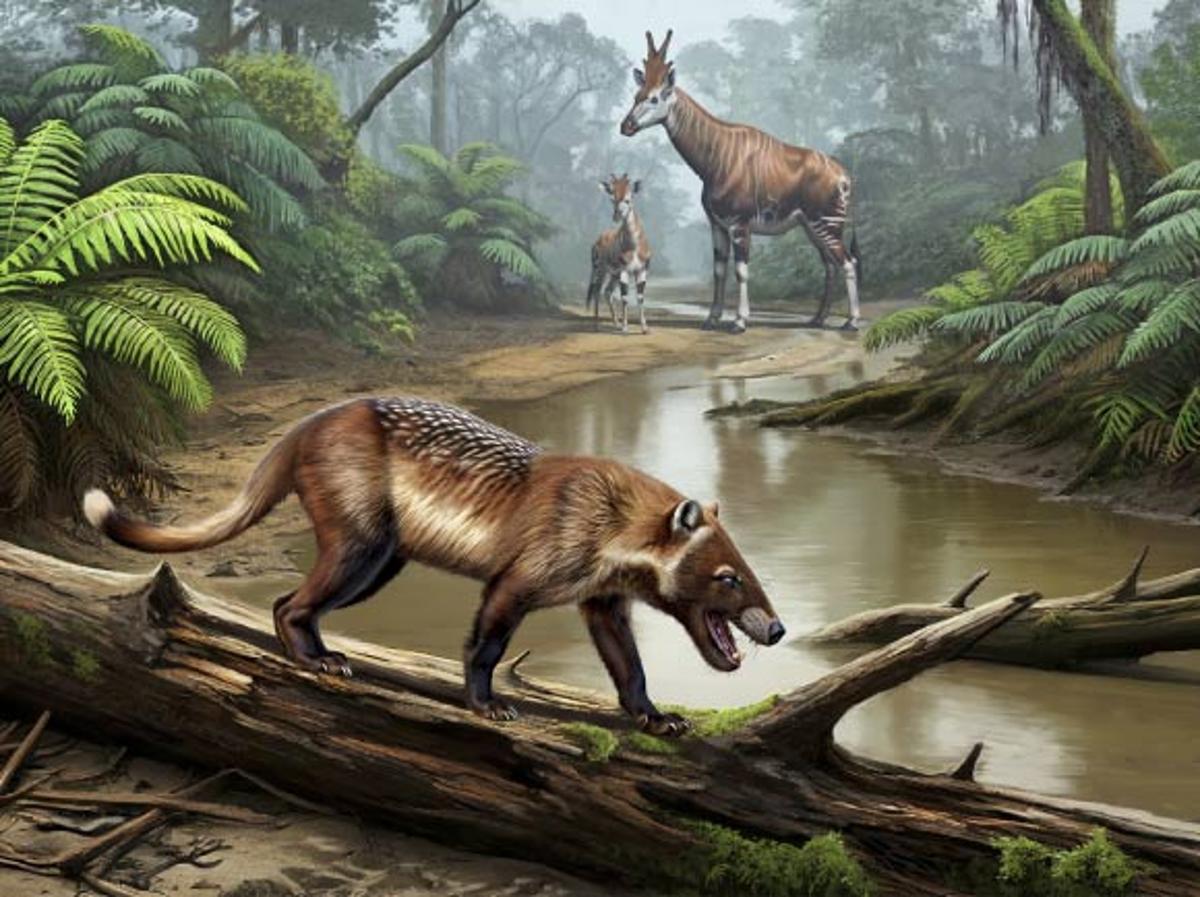
Paleontologists Identify New Hyaenodont Species in Pakistan
Why It Matters
The finds reshape understanding of Miocene predator biogeography, showing African‑Asian migrations and competition that likely contributed to hyaenodont extinction. They also provide a new reference point for studying climate‑driven ecosystem changes in South Asia.
Key Takeaways
- •New species Metapterodon anri identified from Pakistani Miocene fossils
- •500 kg hyaenodont may have rivaled polar bears in size
- •First Hyaenodon specimens recorded in South Asia, dating 9.5‑14 Myr
- •Evidence of African‑Asian hyaenodont migration before carnivoran dominance
Pulse Analysis
The Miocene epoch was a crucible for mammalian carnivores, and hyaenodonts once ruled the predatory niche across Afro‑Eurasia. The recent Pakistani discovery adds three distinct taxa to the fossil record: a massive, polar‑bear‑sized hyaenodont tentatively linked to Megistotherium or Hyainailouros, a 30‑kg Hyaenodon representing the youngest known occurrence of the genus, and the newly named Metapterodon anri, a 15‑kg species previously confined to African deposits. Each specimen, recovered from the Chinji and Nagri formations of the Siwaliks, provides rare anatomical detail that helps refine size estimates, dietary specialization, and developmental stages of these extinct hypercarnivores.
Beyond taxonomy, the fossils reshape our view of Miocene predator dynamics. The presence of Metapterodon in South Asia confirms a previously undocumented dispersal route from Africa into the Indian subcontinent, suggesting that hyaenodonts exploited emerging corridors before the rise of modern carnivorans. Co‑occurrence with early carnivoran fossils hints at direct competition, a factor many researchers believe accelerated hyaenodont decline. By mapping these overlaps, scientists can better model how ecological pressure and climate cooling in the late Miocene reshaped trophic structures, ultimately leading to the extinction of hyaenodonts and the dominance of feliform and caniform lineages.
For paleoecologists and climate scholars, the Pakistani assemblage offers a tangible snapshot of a transitional ecosystem. It underscores how shifting temperatures and habitat fragmentation influenced mammalian migrations and community composition—a pattern echoing today’s biodiversity challenges. As researchers integrate these findings with isotopic and sedimentary data, they will gain clearer predictions about how modern predators might respond to rapid environmental change, reinforcing the value of deep‑time studies for contemporary conservation strategies.
Paleontologists Identify New Hyaenodont Species in Pakistan
Comments
Want to join the conversation?
Loading comments...